News

Cyara Launches Unified AI-Led CX Assurance Platform for the Enterprise
customer experience management 16 Jul 2025
In a major step toward redefining customer experience in the AI era, Cyara has officially launched its next-generation CX assurance platform—a unified solution designed to help enterprises deploy AI at scale, prevent costly customer experience failures, and accelerate innovation across all engagement channels.
With fragmented tools and manual QA processes still hampering many CX efforts, Cyara’s platform offers a tightly integrated suite that combines AI validation, real-time performance monitoring, and no-code test automation into a single enterprise-grade solution. The goal? Replace the patchwork of legacy systems and provide consistent, high-quality CX across voice, digital, and generative AI-powered channels.
“We created the CX assurance category—and now we’re redefining it,” said Cyara CEO Rishi Rana. “These innovations represent the most complete and trusted enterprise-grade CX assurance available today.”
Scaling Global CX, One Carrier at a Time
Cyara's global footprint is expanding fast. Its Pulse 360 engine now spans over 360 carriers in 120+ countries, providing enterprises with unmatched visibility into real-world CX quality and AI system behavior. That scale helped Pulse 360 earn a Customer Magazine Product of the Year Award, validating its status as a go-to for global enterprises managing massive, distributed CX networks.
Built for the AI-First Enterprise
With generative AI rapidly reshaping the customer service landscape, Cyara is leaning into the shift with three headline features aimed at boosting trust, productivity, and safety in AI deployments:
-
AI Trust: Cyara’s award-winning validation suite for GenAI-powered interactions helps detect hallucinations and brand-damaging responses through FactCheck and Misuse modules. In just six months, it’s analyzed over 500,000 AI-generated replies, reducing manual QA effort by 80%. Fortune 50 firms are already embedding it into their pipelines to meet rising compliance and safety standards.
-
Cyara Agent Assist Assurance (AAA): As Agent Assist tools proliferate, Cyara AAA is the first purpose-built solution for validating their real-time performance. It ensures AI-guided support tools are accurate and contextually helpful—critical for high-stakes sectors like banking and healthcare.
-
Cyara Copilot: An agentic AI companion that offers contextual guidance directly within the Cyara platform—and even inside Slack—Cyara Copilot helps QA and CX teams get from problem to solution faster, dramatically improving time-to-insight.
Leading the Shift to Agentic AI
As AI evolves from reactive tool to autonomous partner, Cyara is laying the groundwork for the next wave: Agentic AI. Unlike basic bots, agentic systems can flag compliance issues, adapt workflows in real time, and continuously learn—delivering CX improvements without constant human direction.
Industry signals are aligned. Deloitte projects that 25% of GenAI adopters will deploy AI agents by 2025, and that number will double by 2027. Cyara's next-gen architecture, anchored by AI Trust, Copilot, and AAA, is built for exactly this future.
Test Automation That Anyone Can Use
No-code is no longer a nice-to-have—it’s an expectation. Cyara’s Test Case Designer brings visual, no-code test creation to CX professionals, streamlining testing and empowering teams outside of engineering. Already used by more than 100 enterprise teams, it’s been a game-changer for collaboration and speed.
And for teams seeking more than dashboards, Intelligent Insights turns CX data into real-time intelligence—allowing businesses to identify performance gaps and act immediately. A leading U.S. healthcare provider described it as “immediate value,” while a major bank noted how it clarified process improvements without any steep learning curve.
The Bottom Line
In a CX world defined by increasing complexity and AI integration, Cyara’s next-gen platform doesn’t just keep pace—it’s built to lead. With unified testing, real-time monitoring, and powerful AI guardrails, the platform gives global enterprises the confidence to scale innovation without risking customer satisfaction.
For businesses navigating a fast-changing CX landscape, Cyara may just be offering what the industry needs most: visibility, speed, and trust—at scale.
Get in touch with our MarTech Experts.

Prescient AI Redefines Marketing Forecasting with Next-Gen Decision Intelligence
artificial intelligence 16 Jul 2025
In a bold challenge to the outdated foundations of marketing measurement, Prescient AI has launched what it calls the first new model architecture since the dawn of marketing mix modeling (MMM) in the 1960s. And it’s not a retrofit. Built entirely from scratch, Prescient’s platform is rewriting the rules of media attribution, campaign forecasting, and spend optimization—with a level of accuracy and insight that legacy models can’t touch.
Marketing leaders have long struggled with lagging MMM frameworks—clunky, correlation-heavy models based on regression math designed for simpler times. Prescient’s new engine replaces these blunt tools with what it dubs a “decision intelligence” platform—capable of parsing today’s high-speed, high-complexity media environments with precision.
“Prescient’s model sets a new benchmark for insight and forecasting accuracy,” said David Baker, Chief Digital Officer at Beekman 1802, adding weight to the claim. Baker, who’s worked with MMM systems for over 15 years, calls the technology “true innovation,” not just an incremental upgrade.
Built From Scratch, Because the Old Math Just Doesn’t Cut It
Rather than polish up dated regression models like most modern MMM providers, Prescient's team made the radical decision to start from zero. CTO and cofounder Cody Greco explained why: “We put every available open-source model to the test... and realized building on them would limit us. So we started over.”
That blank-slate mindset paid off. Prescient’s new model isn’t just about seeing what worked—it’s about uncovering why it worked. It identifies cause-and-effect relationships between campaigns and outcomes, handles multi-touch dynamics with daily granularity, and accounts for real-world marketing behaviors—like halo effects, nonlinear ad saturation, and channel interdependence.
What the Model Delivers
Prescient’s reimagined platform brings together some powerful new capabilities, already live:
-
Retail Attribution: Unlike traditional models that treat channels as silos, Prescient tracks media influence across direct-to-consumer (DTC), wholesale, retail, and Amazon. Marketers get a unified view of where media spend actually converts, and how campaigns amplify each other.
-
Granular, Daily Forecasting: Campaign-level performance is refreshed daily, not monthly or quarterly—allowing agile optimization at a pace that reflects today’s digital environments.
-
Cause, Not Just Correlation: The model goes beyond pattern-spotting to detect true causality in media impact, allowing marketers to act on insights, not assumptions.
-
Adaptive Efficiency Modeling: Instead of assuming a linear relationship between spend and return, the platform recognizes that each channel, brand, and campaign has its own efficiency curve.
-
Agnostic Data Ingestion: Brands can feed in third-party measurement data from MTA, incrementality tests, MMM tools, or even post-purchase surveys. The model doesn’t dictate the “right” source—it validates all of them for consistency, transparency, and insight quality.
Independent by Design
Prescient’s independence may be its biggest strategic asset. As major ad platforms bolt MMM into their broader offerings, they often blur the line between measurement and media sales. Prescient, in contrast, takes no media dollars—giving brands confidence that insights and recommendations aren’t biased by a vendor’s agenda.
“Optimizing paid media with incomplete data is like flying blind,” said Connor Rolain, Head of Growth at HexClad. “Prescient gives us a complete, daily-updating picture of what drives sales across our ecommerce store and Amazon. This next evolution of the model lets us do the same for retail—and that's a game-changer.”
The Future of Decision Intelligence
Fresh off being named Predictive Modeling Solution of the Year by the 2025 AI Breakthrough Awards, Prescient is eyeing a broader application for its platform. While marketing optimization is the first battlefield, its architecture has potential well beyond media—into finance, supply chain, and any domain where predictive agility is now a business imperative.
In an industry defined by borrowed math and outdated benchmarks, Prescient’s proprietary model offers something rare: a truly new foundation for faster, smarter, and more confident marketing decisions.
Get in touch with our MarTech Experts.

iHomefinder Appoints Cale Bruckner to Lead AI Product Strategy
artificial intelligence 16 Jul 2025
iHomefinder, the real estate tech company behind the AI-powered Max™ Growth Operating System, has appointed seasoned product executive Cale Bruckner as its new Vice President of Product. The move reflects iHomefinder’s sharpened focus on AI-driven automation and smarter lead engagement for real estate and mortgage professionals.
Bruckner brings more than 25 years of product innovation experience, including a stint as President of Concentric Sky, where he led award-winning AI initiatives adopted by Fortune 500 firms and global institutions. From startup scrappiness to M&A integrations, Bruckner has operated across the full spectrum of product lifecycle and scale.
Now, he’s stepping into a space that’s both high-touch and high-tech: the everyday workflows of real estate agents and lenders navigating one of the most volatile markets in years.
“Cale's blend of technical rigor and customer empathy is exactly what Max needs for its next chapter,” said Nick Parmenter, President of iHomefinder. “He has a proven ability to turn emerging technology into products agents actually use—and love.”
From Dashboards to Real-Time Intelligence
Max™, iHomefinder’s AI-powered platform, promises more than just lead tracking—it aims to be a real-time intelligence layer for agents and loan officers. Bruckner’s appointment is expected to accelerate Max’s evolution into a true growth operating system, one that seamlessly fits into mobile-first workflows and provides actionable insights exactly when agents need them.
“Agents don't need more dashboards—they need intelligence that shows up at the right moment,” said Bruckner. “iHomefinder has the data and the vision to deliver that, and I'm excited to help unlock the next wave of innovation.”
Expect the roadmap ahead to lean into predictive insights, adaptive automation, and tighter integrations—especially in a landscape where timing and personalization can make or break a deal.
The Competitive Context
As the proptech and mortgage tech sectors become increasingly crowded with AI buzz, Bruckner’s hire signals that iHomefinder isn’t just playing with the latest tools—it’s betting on practical AI that solves day-to-day problems. While others tout abstract solutions, iHomefinder is focused on utility: using automation to nudge deals forward, not bury agents in complexity.
The appointment also underscores a broader trend: AI product leadership roles are becoming core to how SaaS companies scale their next growth phase. With data-rich verticals like real estate ripe for disruption, Bruckner’s role could define not just the future of Max, but the evolving expectations of digital-first agents and brokers.
Get in touch with our MarTech Experts.
Operative Taps AI, Cloud, and Support Veterans to Power Next-Gen Media Tech
artificial intelligence 16 Jul 2025
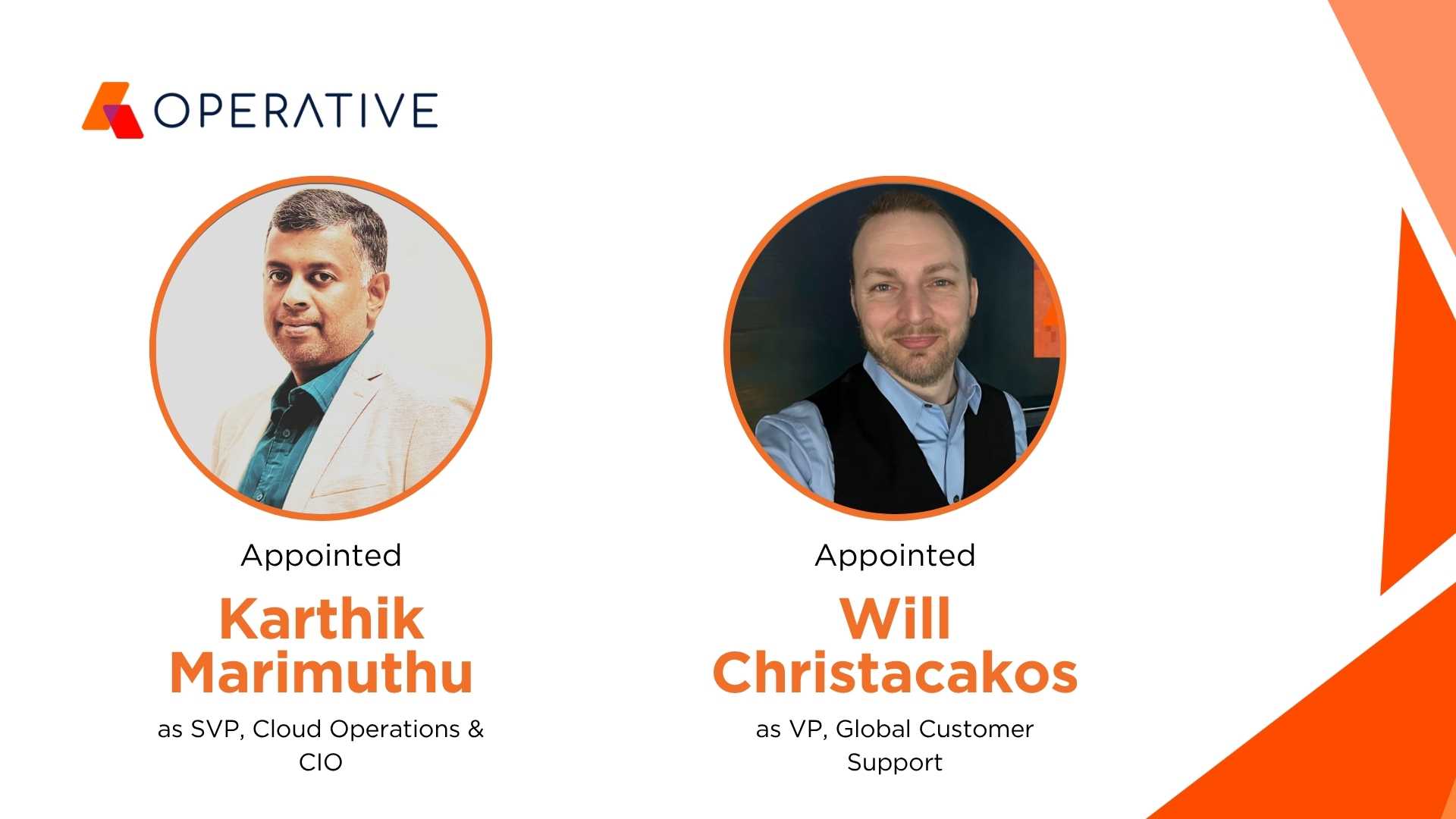
In a move signaling deeper commitment to innovation and operational scale, Operative has appointed three heavyweight executives to lead its charge across AI, cloud infrastructure, and global customer support. The new hires include Nick Thor as Head of AI, Karthik Marimuthu as SVP of Cloud Operations & CIO, and Will Christacakos as VP of Global Customer Support.
The trio brings a combined firepower of deep tech, SaaS, and enterprise operations experience—timed perfectly as media companies face mounting pressure to modernize their stacks and streamline delivery across both digital and linear ecosystems.
“As media companies evolve how they operate, sell, and connect with audiences, they need partners building for the next era of convergence and automation,” said Operative CEO Michael Grossi. “These new leaders bring critical expertise to deliver transformative solutions across AI, infrastructure, and customer experience.”
Betting Big on AI, with a Generative Edge
At the forefront of this tech upgrade is Nick Thor, a machine learning veteran who now helms Operative’s AI strategy. His remit? Elevate Operative’s generative AI platform, Adeline, and push the boundaries of agentic systems, predictive automation, and cross-channel workflow intelligence. In an industry hungry for more flexible and scalable solutions, Thor’s appointment signals Operative’s intent to stay competitive in the accelerating AI arms race gripping the adtech and martech sectors.
Expect a sharper focus on AI interoperability—especially as media clients demand smarter automation across programmatic, linear, and addressable inventory planning.
Enterprise-Grade Cloud for Enterprise-Scale Media
Joining as SVP of Cloud Operations and CIO, Karthik Marimuthu will be responsible for optimizing Operative’s global infrastructure. With decades of experience in cloud architecture and systems resilience, Karthik will help ensure Operative’s media clients experience enterprise-grade uptime and performance, even as their operations grow more complex and hybridized.
With ad operations now spanning OTT, CTV, programmatic, and traditional linear, Marimuthu’s role is central to ensuring that Operative’s platform can flex and scale—without cracking under pressure.
CX as a Competitive Advantage
Rounding out the executive additions is Will Christacakos, the new VP of Global Customer Support. A seasoned SaaS leader with a 20-year track record in building world-class support teams, Christacakos will take charge of client retention and experience across all regions and product lines.
In a market where martech and adtech vendors often struggle with fragmented customer support, Christacakos' appointment could help Operative stand out—particularly among global media conglomerates navigating platform unification efforts.
The Bigger Picture
This trio of appointments lands as the media industry pivots hard toward convergence—where content, inventory, and revenue management need to work across every screen and sales channel. Operative’s unified advertising technology platform aims to be the connective tissue that ties it all together.
And while innovation is the banner message here, the real story may be about resilience: investing in the leadership muscle needed to future-proof its offering as client needs grow more complex and expectations soar.
Get in touch with our MarTech Experts.

Lucidya Raises $30M Series B to Scale Arabic-First AI CX Platform
customer experience management 16 Jul 2025
In a record-setting moment for MENA’s AI ecosystem, Lucidya, the Saudi-born customer experience management (CXM) platform, has raised $30 million in Series B funding—the largest AI investment to date in the region. Led by VC powerhouse Impact46 (backers of IPO stars Jahez and Rasan), the round also drew heavyweight support from Aramco’s Wa’ed Ventures, Takamol Ventures, SparkLabs, and returning investors Rua Growth Fund and ARG.
The raise marks a major milestone not just for Lucidya, but for the growing appetite for Arabic-first AI technologies amid a broader digital transformation wave in the region.
Founded in 2016, Lucidya took an early bet on AI long before the hype cycle peaked. That foresight is now yielding returns. “We bet on AI before it became a boardroom buzzword,” said CEO and founder Abdullah Asiri. “That conviction is now making us the go-to AI partner for customer experience in MENA.”
Lucidya operates in 11 countries and caters to enterprise clients across telecom, BFSI, healthcare, hospitality, and the public sector—collectively serving over 75 million people. It’s a client base with a combined market cap north of $250 billion, a testament to the platform’s regional influence.
At the heart of Lucidya’s success is its proprietary Arabic-language AI engine. Boasting over 92% accuracy, it’s a key differentiator in a market underserved by global CRM and CX giants. For many enterprises in MENA, nuanced Arabic understanding isn’t optional—it’s mission-critical. Lucidya offers sentiment analysis, behavioral prediction, and engagement automation with linguistic precision that Silicon Valley rivals still struggle to match.
This linguistic edge is helping Lucidya zero in on the CRM and CX software market in MENA, projected to balloon to $9 billion by 2030. With the new funds, Lucidya aims to expand its AI Agent offering—transforming traditional CX roles into scalable, AI-driven digital workforces.
“We’re not just improving workflows—we’re reimagining what CX looks like in a region where labor and compliance dynamics are unique,” said Asiri. “AI Agents let us tap into the labor economy while maintaining compliance with frameworks like PDPL.”
Impact46’s Basmah Alsinaidi agrees: “Lucidya is solving real regional challenges with a rare combination of defensible tech and strategic grit. They’re poised to define a new category.”
While the Series B round adds significant runway, it also raises the stakes. Lucidya is entering an increasingly competitive AI space, but its Arabic-first foundation and regional focus may give it a home-field advantage. If successful, it won’t just scale CX—it could redefine the role of AI in public and enterprise services across the region.
Get in touch with our MarTech Experts.

Coveo Expands Salesforce Partnership to Ground AI Agents with Enterprise Data
sales 15 Jul 2025
Coveo is doubling down on relevance in AI with a strategic expansion of its partnership with Salesforce—and it’s making a bold push into the future of autonomous digital labor. Announced today, Coveo is bringing its Model Context Protocol (MCP) Server to Salesforce’s AgentExchange, helping AI agents access trustworthy, real-time enterprise data and dramatically cut down on the hallucinations that still haunt generative AI platforms.
In an AI economy where interoperability, governance, and trust matter more than ever, Coveo’s latest move signals a serious step forward in making autonomous agents both useful and business-ready.
Why This Matters: Hallucination-Free AI at Scale
AI agents are only as good as the data they’re grounded in. The Model Context Protocol (MCP)—a Salesforce-driven standard—is designed to help AI agents pull in external data securely and accurately, while ensuring centralized governance and interoperability.
With the new Coveo MCP Server on AgentExchange, enterprise users can link their agents to real-time business data—product catalogs, inventory, customer purchase histories, and more. The result? Smarter, hallucination-resistant AI agents that aren’t just impressive—they’re actually useful in the day-to-day flow of work.
“The future of AI lies in modular, scalable, and standards-based systems,” said Patrick Finn, VP of Alliances at Coveo. “We’re empowering enterprises to build reliable AI agents grounded in real business context.”
What’s Included:
-
Coveo MCP Server for AgentExchange (coming soon): Connects enterprise tools and systems to AI agents via the MCP protocol
-
Coveo for Agentforce (already live): An application that simplifies how end-users interact with intelligent agents by making search and task completion faster and more intuitive
-
Salesforce AgentExchange: A new ecosystem that helps enterprises build, deploy, and scale AI agents with access to pre-validated MCP servers and plug-and-play capabilities
Together, these tools enable companies—especially in e-commerce—to automate high-volume interactions with contextual intelligence. Think AI agents that:
-
Recommend products based on live inventory
-
Track shipping or handle returns in real-time
-
Automate merchandising decisions using data from past performance
For E-Commerce and Beyond
For online retailers, the expanded partnership means fewer disconnected workflows and more responsive customer experiences. AI agents connected via MCP can personalize interactions, predict behavior, and resolve queries—all without escalating to a human rep unless necessary.
Beyond retail, the tech has implications for industries like finance, healthcare, and enterprise services, where secure access to context-rich data is essential for AI to be effective (and compliant).
“Coveo is at the forefront of grounding GenAI and Agentic AI systems in enterprise knowledge,” said Brian Landsman, CEO of AppExchange and Global Partnerships at Salesforce. “Their MCP integration brings scalable, secure digital labor one step closer to reality for our customers.”
The Bigger Picture: Building a Multi-Trillion Dollar AI Agent Economy
Salesforce has made it clear: AgentExchange and Agentforce are key pillars in its GenAI strategy—a bid to capture a slice of what’s expected to be a multi-trillion dollar “AI agent economy.” Coveo’s deep experience in AI-powered search, personalization, and enterprise knowledge access makes it a natural partner in this emerging landscape.
With this expanded integration, the two companies aim to close the loop between AI performance and enterprise trust, offering customers tools that work intelligently—without guesswork.
Get in touch with our MarTech Experts.

DeepSwap Sets New Standard in AI Video Generation with Breakthrough Character Consistency
artificial intelligence 15 Jul 2025
DeepSwap, a fast-rising player in the AI video generation space, just dropped a serious gauntlet. With a slate of new proprietary technologies and benchmark-shattering performance, the company is positioning itself as a go-to platform for high-fidelity, long-form AI video content—without the janky face flickers, motion jerks, or uncanny visuals that plague competitors.
And yes, it’s turning heads—literally and figuratively.
Character Consistency Hits 96.2%—A New Industry Benchmark
One of the thorniest challenges in AI-generated video is keeping the same face consistent across frames—especially when that face is in motion. DeepSwap claims it has cracked that nut with a proprietary duo:
-
Dynamic Feature Disentanglement (DFD)
-
Deep Facial Fusion (DFF)
Together, these systems deliver a 96.2% character consistency rate, ensuring a person’s digital likeness stays true to their real-life identity throughout a video.
“With 96.2% face-ID consistency, users can trust their digital self to look like... well, themselves,” said Penyne Wu, CEO and Co-Founder of DeepSwap AI. “This is a quantum leap for anyone who cares about realism—especially in professional use cases.”
Text Prompts That Actually Work
AI tools that promise text-to-video often leave users guessing what they'll get. DeepSwap claims a 93.4% text-to-video alignment, meaning the visuals closely match user instructions. This tight alignment reduces the trial-and-error loop that frustrates creators and significantly speeds up production cycles.
Visuals Worthy of the Big Screen
With a mean visual quality index of 98.7, DeepSwap’s generated clips reportedly rival professional cinematography. That’s not hyperbole—it’s the result of an end-to-end optimization pipeline that ensures everything from lighting to pixel detail hits near-cinematic fidelity.
Couple that with 98.3% feature preservation—even in high-motion sequences—and the result is broadcast-ready AI content.
More Than Just a Short Clip Generator
Where many AI video platforms cap out at a few seconds of usable content, DeepSwap can deliver up to 20 seconds of continuous video—without stitching artifacts. That opens the door for:
-
Longer-form storytelling
-
In-app marketing videos
-
Personalized content for education, entertainment, or commerce
And it all happens inside one platform.
Face-Swap 2.0: Seamless and Stable
Face-swapping is DeepSwap’s legacy play, but the new system doesn’t just swap—it integrates. The updated module maintains the same 96.2% character consistency, allowing seamless face placement across different scenes, lighting conditions, and even complex movements. Think more Hollywood deepfake, less meme generator.
Stability, Physics, and Camera Control—No Compromises
-
99.5% pixel stability
-
<0.5% flicker rates
-
97.8% realism in physics rendering
-
98.7% motion smoothness with low jerk ratings (<2%)
-
Sub-0.05° precision in pan, tilt, and zoom
Together, these numbers paint a picture of a platform not just built for fun, but one that can handle professional-grade production requirements.
Why This Matters
As the demand for video content explodes—across marketing, education, training, and entertainment—the ability to generate long, realistic, brand-safe videos without a full production team is a game-changer. DeepSwap’s technology is positioning the platform to:
-
Disrupt traditional video workflows
-
Serve as a creative engine for agencies and brands
-
Power personalized content at scale
Enterprise clients eyeing cost savings without compromising production value will find DeepSwap’s offering particularly compelling.
With this release, DeepSwap doesn’t just join the AI video race—it leads it.
Get in touch with our MarTech Experts.

Brand Networks Launches Aimy: AI-Powered Ad Assistant for SMBs
advertising 15 Jul 2025
Brand Networks (BN), the Augeo-owned digital advertising innovator, is making paid media radically easier—and more accessible—for small and mid-sized businesses. Today, the company introduced Aimy, an AI-powered advertising assistant that helps users plan, launch, optimize, and analyze ad campaigns across Google, Meta, X (formerly Twitter), and soon LinkedIn and TikTok, all with minimal input and zero media-buying experience required.
Billed as the first solution of its kind, Aimy is now available for early access.
Advertising Without the Complexity
For most SMBs, digital advertising often feels like a high-stakes maze: multiple platforms, shifting algorithms, confusing metrics, and tools that seem built for agencies—not local teams. Aimy flips the script by offering a goal-based, AI-guided experience that handles everything from targeting and creative suggestions to real-time performance tuning.
“Aimy isn’t here to replace creativity—it’s here to remove barriers,” said Mike Garsin, CEO of Brand Networks. “We’re giving lean teams access to media tools that used to be reserved for big budgets and expert operators.”
Key Features of Aimy
-
AI-driven campaign planning based on business goals
-
Automated creative suggestions with live previews
-
Cross-channel media buying (Google, Meta, X, with LinkedIn and TikTok next)
-
Real-time pacing alerts and continuous optimization
-
Custom reporting dashboards tailored to campaign objectives
-
Insights backed by 15+ years of BN’s media buying data and benchmarks
It’s not just for SMBs either—Aimy is scalable, designed to support agencies, enterprise platforms, and large brands managing multiple local campaigns.
A Legacy of Innovation, Extended to the Long Tail
This isn’t BN’s first rodeo. The company has been pushing the limits of ad tech since 2007—pioneering automated cross-channel optimization, developing ad products for X (like media polls and conversation cards), and launching hyperlocal targeting solutions for programmatic and social.
With Aimy, BN is extending its capabilities to a previously underserved audience: businesses without media teams, but with serious ambitions.
Mobile-First, Performance-Forward
Aimy is also optimized for life on the move. Users can launch and manage campaigns from desktop or mobile, get real-time alerts, and make changes on the fly—ideal for small business owners who don’t have time to sit in dashboards all day.
As AI continues to reshape digital marketing, Aimy represents a refreshing take: less hype, more help. It’s not trying to do everything—it’s trying to do the things that matter, and do them well.
Available now in early access, Aimy might just be the assistant that levels the media playing field—giving every business, no matter its size, a shot at running smart, high-performing campaigns without the usual overhead.
Get in touch with our MarTech Experts.
Page 358 of 645
Most Recent



Website Architecture Emerges as a Core SEO and UX Lever
EIN Presswire

Fresha Expands DACH Push With New Germany GM
Business Wire


Influ2 Launches MCP to Connect Contact-Level ABM With AI
Business Wire