News

Thoughtworks Wins Global Award for AI-Powered Customer Insights
artificial intelligence 2 Oct 2025
Thoughtworks has turned its market intelligence team into a growth engine—and it just earned global recognition for it. The tech consultancy won Customer Insights Program of the Year at the 2025 ITSMA Global Marketing Excellence Awards, which honor innovation and measurable impact in B2B marketing.
The accolade highlights Thoughtworks’ AI-first overhaul of its client intelligence services, a program that has already proven to be a multimillion-dollar commercial driver by cutting time-to-insight and embedding intelligence directly into sales workflows.
From Research to Growth Partner
What impressed the judging panel wasn’t just efficiency—it was the scale of impact. “Thoughtworks stands out for its exceptional quantifiable results and innovative scaling of insights through AI-powered automation,” said the ITSMA committee, noting the company’s ability to generate ROI without requiring massive new resources.
By automating data-heavy research tasks, Thoughtworks freed up its analysts to focus on strategy. The shift is striking: researchers now spend over 80% of their time on higher-value analysis, boosting both impact and job satisfaction.
AI Agents Meet Human Insight
The program runs on a human-AI collaboration model, combining Gemini LLM and other AI-powered intelligence platforms within the company’s existing Google ecosystem. That meant no lengthy build from scratch—instead, the team used Google Apps Script to create a self-service experience layer for sales and marketing.
The result: a platform that delivers curated client intelligence in minutes, slashing turnaround time by 50% while keeping quality intact. Sales teams now access insights directly inside their workflows, helping them pursue opportunities with precision and strengthen client relationships.
What’s Next: A “Super-Agent”
The company isn’t done. The next phase is ClientIntelAI, a “super-agent” that will connect multiple existing agents and apps into a single orchestrated experience. If it works as planned, it could mean fully automated end-to-end intelligence workflows—a move that could reset expectations for how consultancies operationalize customer insights.
The Bigger Picture
For B2B firms, the award underscores a growing trend: customer intelligence is moving from static reports to dynamic, AI-powered engines. Rivals from Deloitte to Accenture have been exploring similar models, but Thoughtworks’ recognition signals how quickly this shift is becoming table stakes for enterprise sales and marketing teams.
“Winning the award is a testament to our commitment to AI-first innovation,” said Julie Woods-Moss, CMO at Thoughtworks. “Our research team led the way in adoption and growing AI mastery across marketing. The transformation empowers sales with rapid, actionable insights that fuel deeper client engagement.”
Bottom Line
For Thoughtworks, this isn’t just an award—it’s validation that AI-driven intelligence isn’t a side experiment anymore, but core to revenue growth. And in a consultancy market crowded with digital transformation promises, execution—and recognition like this—might just be the differentiator.
Get in touch with our MarTech Experts.
Superfiliate Taps Meta APIs to Automate Creator Discovery at Scale
marketing 2 Oct 2025
The $203 billion creator economy has a new infrastructure play. Superfiliate, a creator marketing platform built for the age of social commerce, has teamed up with Meta to launch Creator Discovery – Enabled by Meta APIs, a tool designed to automate one of the industry’s most painful bottlenecks: finding the right creators at scale.
Instead of the painstaking, manual process of scrolling through feeds—or worse, relying on shady data-scraping tools—brands can now tap into authenticated, first-party Instagram creator data through Meta’s official creator marketplace APIs. That means AI-driven, Netflix-style recommendations for creators who align with a brand’s audience, tone, and engagement needs.
Fixing the Creator Economy’s Most Expensive Problem
For brands, creator marketing has long been both a goldmine and a headache. Partnership ads—content boosted directly from creator handles—are outperforming traditional formats, but identifying the right collaborators has remained time-intensive and costly. Superfiliate’s integration aims to collapse that cycle.
The system delivers:
-
AI-driven lookalikes – Feed the system high-performing creators and get instant recommendations for similar talent with aligned demographics, engagement, and style.
-
Platform-native intelligence – Insights pulled directly from Instagram’s creator marketplace ensure compliance and accuracy.
-
A compliant foundation – Unlike scraping-based rivals, this setup stays within Meta’s developer rules, cementing brand safety.
Andy Cloyd, Superfiliate’s co-founder and CEO, framed it bluntly: “Partnership ads are outperforming every other format, but the discovery process has been broken. Now, we can scale what should be brands’ most profitable channel.”
From Experiment to Infrastructure
Superfiliate’s move comes as platforms from TikTok to YouTube and Snapchat ramp up creator monetization programs. The Meta-backed integration is less about experimentation and more about professionalizing creator marketing—putting it on par with programmatic advertising in digital media.
Anders Bill, co-founder and CPO, added: “We’ve moved creator discovery from manual research to data-driven matching. The compliance piece matters just as much as the accuracy—it’s the infrastructure for the next decade of digital marketing.”
With the creator economy projected to balloon to $528 billion by 2030, the timing couldn’t be sharper. The new tool positions creator partnerships as core marketing infrastructure, not side experiments. And as partnership ads trend toward dominance in social advertising, the brands that can automate discovery and activation at scale are likely to win big.
Get in touch with our MarTech Experts.

Astreya Taps 3CLogic to Supercharge IT Service Delivery with Voice AI
audio technology 2 Oct 2025
The help desk is finally getting a voice upgrade. Astreya Partners, a global IT managed services provider (MSP) serving some of the world’s biggest tech companies—including six of the so-called Magnificent Seven—has chosen 3CLogic to power its ServiceNow-based contact center with AI-driven voice technology.
The move reflects a growing trend in IT services: ditching email-heavy workflows in favor of conversational, real-time support that actually matches the urgency of enterprise IT issues. With more than 2,400 IT professionals spread across 40+ countries, Astreya needed a solution that could modernize interactions while squeezing more efficiency from its sprawling service operations.
Why Voice AI Now?
Email still dominates enterprise IT support—but it’s often the slowest way to solve complex problems. By bringing in 3CLogic’s Voice AI and omnichannel contact center platform, Astreya aims to deliver faster resolutions and create a unified workspace for agents, administrators, and clients.
Key features of the integration include:
-
Omnichannel platform: A single workspace that combines voice with ServiceNow’s digital channels, cutting down on “swivel-chairing” between systems.
-
Voice AI & automation: Conversational voicebots powered by ServiceNow data handle common requests while escalating complex cases to human agents.
-
Real-time transcription & AI summaries: Calls are automatically transcribed and condensed into generative AI-powered notes, saving agents time and reducing errors.
-
AI-powered coaching & QA: Speech analytics and performance monitoring let IT teams train and optimize at scale without manually reviewing every call.
A Smarter Service Desk
Romil Bahl, Astreya’s CEO, called the partnership a way to “deliver digital workplace services that scale, adapt, and continually raise the bar for service excellence.” His COO, Jothiganesh Nagarajan, added that the collaboration will bring “intelligent self-service, conversational AI, and sentiment analytics” to the company’s service desks—positioning Astreya as a leader in AI-driven IT support.
3CLogic, for its part, sees the ServiceNow tie-in as a natural fit. “IT departments are the backbone of any modern organization,” said Bob Doherty, VP of Sales at 3CLogic. “Embedding this functionality into existing ServiceNow workflows to drive exponential ROI is a no-brainer.”
What’s Next
The rollout starts with Astreya’s Digital Workplace Services division but won’t stop there. The MSP plans to extend 3CLogic’s capabilities across more business units, betting that AI-powered service desks will not just reduce costs but also improve client satisfaction—a critical differentiator in the competitive managed services market.
With IT service desks under pressure to deliver faster, leaner, and smarter support, Astreya’s playbook may become the template for other global MSPs looking to marry ServiceNow’s ITSM backbone with AI-driven voice automation.
Get in touch with our MarTech Experts.

Cadent Closes Upfront With 26% Growth as Advertisers Demand Predictive Precision
advertising 2 Oct 2025
Cadent, the predictive advertising company, has wrapped its annual Upfront with a 26% year-over-year surge, signaling that advertisers are increasingly betting on predictive intelligence to navigate a fractured video landscape. The company’s pitch—unifying audiences across linear and digital while delivering digital-style accountability—appears to be resonating in a market that’s demanding both scale and measurable outcomes.
Predictive Advertising Gets Its Moment
At the core of Cadent’s growth is its Predictive Intelligence engine, honed over 15 years and powered by more than 22,000 custom machine learning models. Instead of waiting until after impressions are bought to optimize, Cadent scores them in advance, continuously adjusting campaigns in real time. The result: video can now be transacted and measured with the precision of digital, while still benefiting from the reach and certainty of traditional Upfront deals.
The 2025 Upfront cycle brought 22 new advertisers into Cadent’s fold, alongside a 12% boost in linear commitments—outpacing the broader TV marketplace, which continues to wrestle with declining viewership and splintered audiences.
“Advertisers are saying it loud and clear—they want more flexibility, proof of performance, and ways to bring digital accountability to all media,” said Doug Rozen, President of Cadent. “Our Upfront results demonstrate the market’s confidence in our ability to deliver any audience across a fully optimized media supply path.”
Convergence Is the New Battleground
The ad industry has been steadily moving toward converged media—where linear TV and digital channels are planned and measured in one system. Cadent’s growth underscores just how central that convergence has become. In the first half of 2025 alone, Cadent saw nearly 50% growth in digital campaigns and a whopping 137% increase in connected TV (CTV) spend, as advertisers reallocate budgets toward formats that bridge TV-style storytelling with digital accountability.
Cadent’s reach is bolstered by partnerships with more than 200 publishers, enabling advertisers to activate campaigns across premium inventory with the same predictive modeling used in digital performance channels. Today, over 1,500 advertisers and agencies lean on Cadent’s platform—including 70+ self-service agencies representing 850+ brands.
Why It Matters
The results reflect a broader shift in advertiser expectations. Economic uncertainty, fragmented audiences, and mounting pressure for ROI have forced marketers to demand more than just reach. The big win for Cadent is positioning itself as both a bridge and a filter: unifying audiences across channels while ensuring every impression is scored for its potential to drive outcomes.
For rivals in the converged TV space—from The Trade Desk to Comcast’s FreeWheel—the takeaway is clear: advertisers don’t just want scale, they want predictive precision. And Cadent’s Upfront haul shows that if you can offer both, the budgets will follow.
Get in touch with our MarTech Experts.
Workato Launches Enterprise MCP to Make AI Agents Actually Useful in Business
automation 2 Oct 2025
Workato, best known for its low-code automation platform, is making a bold play for the future of enterprise AI. Today, the company unveiled Workato Enterprise Model Context Protocol (MCP), which it claims is the most complete and secure way to connect large language model (LLM) agents—think ChatGPT, Claude, Amazon Q, and Google Gemini—with the messy reality of enterprise applications and workflows.
It’s a move aimed squarely at solving one of the biggest headaches in AI adoption: how to let AI agents take real action with real data, without opening a Pandora’s box of security risks or unreliable automation.
Why MCP Matters Now
For the past year, enterprises have been experimenting with AI copilots and chatbots, hoping to translate hype into productivity. The problem? Open-source MCP servers—essentially middleware for AI agents—are everywhere, but most lack the enterprise-grade security, identity management, and governance that IT leaders demand.
“MCP has shown great promise, but hasn’t delivered when it comes to seeing value with core business processes,” said Adam Seligman, CTO of Workato. “Workato Enterprise MCP changes that by bringing the full spectrum of business processes, from the front office to the back office and everything in between, to AI agents through MCP.”
The stakes are high. Analysts predict MCP could become the de facto standard for how AI agents talk to enterprise apps. But without guardrails, those same agents risk turning into compliance nightmares or worse—unreliable assistants that break workflows instead of accelerating them.
Workato’s Pitch: Secure, Managed, Enterprise-Grade
Workato is positioning its Enterprise MCP as the antidote to “DIY disasters.” Instead of running open-source servers full of untrusted code, enterprises can use Workato’s fully managed, serverless MCP servers that come pre-loaded with governance, observability, and enterprise-grade security.
Some highlights:
-
Instant integration with leading agents: Works out of the box with ChatGPT, Claude, Cursor, Amazon Q, and Google Gemini.
-
Enterprise-ready from day one: Scoped tokens, approval workflows, audit trails, and no infrastructure to manage.
-
100+ prebuilt MCP servers: Covering everything from Salesforce, Workday, and Atlassian to Box, Stripe, NetSuite, and even Reddit.
-
12,000+ connectors & 900,000 community recipes: Transform existing Workato automations into AI-ready “skills” without rewriting code.
-
AI agents that do actual work: From HR onboarding (payroll setup, identity provisioning, SSO) to marketing pipeline generation (mining Gong calls, drafting Outreach sequences).
By comparison, rivals in the integration and automation space—think Zapier, MuleSoft, or even ServiceNow—have been slower to explicitly embrace MCP as the glue between agents and enterprise software. Workato is trying to seize first-mover advantage by not only embracing MCP but reimagining it as a fully managed service.
Big-Name Partners on Board
Workato isn’t going at it alone. The Enterprise MCP launch comes with endorsements and integrations from Anthropic, AWS, Atlassian, and Box.
-
Atlassian says the combo unlocks autonomous actions across Jira and Confluence with enterprise-grade guardrails.
-
Box is enabling multi-file analysis, search, and data extraction for AI agents working across enterprise content.
-
Anthropic sees MCP powering Claude’s “intelligent, context-aware automation.”
In other words, Workato isn’t just launching a product—it’s building an ecosystem around MCP.
The Bigger Picture: The “Agentic Enterprise”
Workato has been talking a lot about the “Agentic Enterprise,” a vision where AI agents don’t just sit on the sidelines answering questions but actively run business processes across departments.
With Enterprise MCP, Workato claims it can now turn any of its 900,000+ automation “recipes” into MCP tools that AI agents can call securely. It’s the kind of infrastructure play that, if it works, could transform AI from a shiny demo into a backbone of enterprise operations.
The company argues this is the next logical step after a year of copilots and copilots-everywhere hype. “Trusted agents are not just a nice-to-have, but a requirement,” said Dave Marcus, Principal Analyst at Analysis.tech. “By building on its foundation in enterprise integration, Workato's MCP platform delivers high-quality, secure, and well-governed MCP services.”
Why This Matters for the Market
If Cadent’s predictive ad platform showed us how AI can sharpen media buying, and if ServiceNow’s AI push is about optimizing IT workflows, Workato is aiming at the plumbing—the orchestration layer that makes AI agents usable across the enterprise.
And in a fragmented AI ecosystem where every cloud vendor is pushing its own assistant, Workato’s MCP could become the neutral middle layer enterprises need. Think of it as the “USB standard” for AI agents. Without it, companies risk a spaghetti mess of custom integrations, compliance headaches, and brittle bots.
The question now: will Workato’s head start on MCP orchestration make it the default enterprise standard, or will cloud heavyweights eventually swallow the space whole? Either way, enterprises just got a clearer, safer path to put AI agents to work.
Get in touch with our MarTech Experts.

Vocodia Appoints Paul Taylor as Chairman, Targets AI-Driven Customer Engagement Pivot
artificial intelligence 2 Oct 2025
Vocodia Holdings Corp (OTC: VHAI) is taking a bold step to reposition itself in the booming AI customer service market. The company announced today that Paul Taylor has been unanimously elected Chairman of the Board and interim COO, marking the start of a strategic pivot for its Digital Intelligence Sales Agent (DISA) platform toward collaborative AI networks.
The move comes as AI-driven service automation continues to surge. Analysts forecast the autonomous service market to reach $47 billion by 2030, with a growing share of routine transactions handled by intelligent agents. Vocodia aims to position DISA as a foundational “AI plumbing” layer, managing tasks from customer greetings and qualification to KYC checks and intelligent inquiry routing.
Leadership with Wall Street Credibility
Taylor brings more than three decades of public company turnaround and operational transformation experience. He has advised companies like EdgeMode (OTC: EDGM), Nukkleus (NASDAQ: NUKK), and MGT Capital Investments (OTC: MGTI), and co-founded S4TD LLC for strategic European investments.
“Paul is the ‘grown-up’ in the room,” said Vocodia CEO Brian Podolak. “His strategic vision and operational deal-making will be instrumental in repositioning Vocodia as a key component of collaborative AI networks.”
In his interim COO role, Taylor will oversee austerity measures and operational restructuring, aligning resources with strategic priorities while driving mergers, acquisitions, and shareholder value creation.
DISA’s Strategic Pivot
Vocodia’s pivot redefines DISA from a standalone SaaS contact center solution to a scalable integrative platform. By embedding itself into partner databases and collaborative networks, DISA aims to deliver cost-effective, agentic AI interactions at scale. This aligns with market trends emphasizing AI-assisted customer service, dynamic call routing, and networked support ecosystems.
Industry projections suggest that network-driven AI models could deliver 3-5x valuation multiples, leveraging recurring revenue and scalability. Vocodia’s focus on operational efficiency and strategic partnerships is designed to capitalize on these opportunities.
Looking Ahead
Taylor commented, “By building strategic partnerships and leveraging synergies, Vocodia will deliver innovative, scalable solutions that empower businesses and redefine customer experiences globally.”
With DISA’s integration into collaborative AI networks, Vocodia hopes to enhance market positioning, attract high-value partnerships, and generate sustainable revenue growth, positioning itself as a strategic leader in AI-driven customer engagement.
Get in touch with our MarTech Experts.
">

Inriver Integrates AI Throughout PIM Platform to Boost Product Content Control
artificial intelligence 2 Oct 2025
Inriver is doubling down on AI with major updates to its Product Information Management (PIM) platform, offering brands more control over product content from onboarding to syndication. The new release introduces embedded AI agents, smarter workflows, and expanded distribution options designed to streamline operations and maintain brand consistency across channels.
AI-Powered Workflows and Content Management
Central to the update are two new AI agents—Inspire Generate and Translate—which collaborate with human teams to enrich and translate product information. GPT-5 is integrated directly into Inriver Inspire, allowing users to leverage advanced AI without leaving the platform. The system also incorporates brand terms, glossaries, and style guidance to ensure accuracy and consistency across all touchpoints.
“Our customers want to harness AI to streamline data ingestion, improve quality, and automate processes without losing trust or control,” said Rohit Goyal, CEO of Inriver. “With this release, we’ve embedded AI directly into workflows, empowering teams to model business processes into AI-driven automation while enhancing collaboration.”
Enhanced Syndication and Digital Shelf Accuracy
Inriver has also upgraded its syndication capabilities with Syndicate Advance, enabling flexible, channel-ready content delivery. New features include:
-
Direct API connectivity to Best Buy
-
ChannelEngine integration with access to 950+ channels and marketplaces
-
Fully managed syndication service for automated, low-lift distribution
Paired with Inriver Evaluate, brands can now deliver accurate product information and monitor its performance across the digital shelf.
Streamlined Content Onboarding and Brand Store Updates
Content Onboarding has been revamped for faster, more accurate data imports, with auto-mapping, formula-driven transformation, error validation, and multilingual support reducing manual work and accelerating time-to-market.
The Brand Store now features smarter search, configurable templates, bulk downloads, public store links, and a built-in CDN for reliable, fast media delivery. The new open store capability allows sharing product content publicly without requiring logins or registrations.
Driving Revenue Through Product Data
With these enhancements, Inriver positions its PIM platform as a complete end-to-end solution, helping brands transform complex product information into revenue-driving assets.
Inriver will showcase the updates at PIMpoint 2025, demonstrating workflows from onboarding and enrichment to syndication, audit, and optimization.
Get in touch with our MarTech Experts.
5WPR Bolsters Digital Firepower With Senior Hires From Zeno
digital marketing 1 Oct 2025
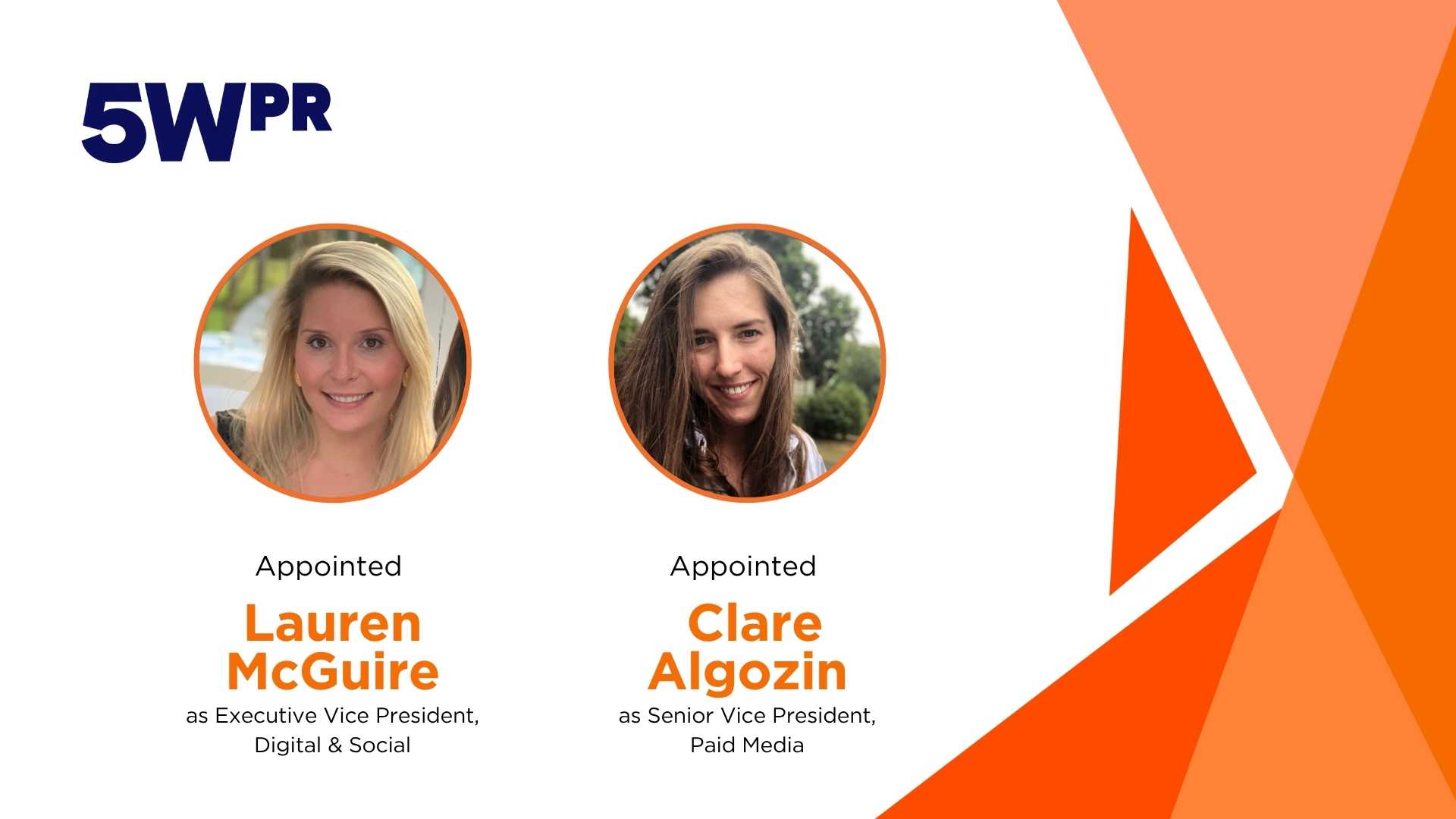
5W Public Relations is doubling down on digital. The New York-based PR agency has tapped two heavyweights from rival Zeno Group—Lauren McGuire as EVP of Digital & Social, and Clare Algozin as SVP of Paid Media—to strengthen its integrated campaign capabilities.
It’s a clear signal: in the high-stakes world of digital and social, 5WPR doesn’t just want to keep pace, it wants to sprint ahead.
The Digital Playmakers
McGuire, who spent more than a decade running digital operations across sectors from healthcare to travel, is known for building scalable systems that keep teams agile when platforms and algorithms shift overnight. At Zeno, she led operations and integration for ZDX, where her playbook was all about marrying emerging tech with efficiency.
Algozin, meanwhile, brings deep expertise in paid media, running multimillion-dollar budgets across social, search, programmatic, and video. Her edge? Using advanced targeting and AI-driven media buying to make campaigns both smarter and faster. She also has a knack for attribution modeling—the kind of data science that can separate real impact from vanity metrics.
Why It Matters
The hires come as agencies across the PR and ad landscape scramble to adapt to what feels like a constantly morphing media ecosystem. With influencer channels maturing, programmatic buying getting more complex, and brands demanding proof of ROI, agencies can’t afford to treat digital as an add-on—it’s the whole show.
Zeno itself has been on a tear in digital innovation, so poaching two of its senior players is a power move for 5WPR. For clients, it could mean more integrated campaigns that blur the lines between earned, paid, and social—a trend we’re seeing not just in PR, but across the martech industry.
The Bigger Picture
5WPR’s CEO Matthew Caiola calls the hires a mix of “operational excellence and strategic vision,” but the subtext is clear: agencies that don’t continually reinvent their digital chops risk falling behind. Competitors from Edelman to Weber Shandwick have been bulking up their own digital divisions, and with brand dollars shifting toward measurable, tech-powered campaigns, talent like McGuire and Algozin may prove to be the ultimate differentiator.
The takeaway? 5WPR is betting big on leadership that can cut through noise, optimize at speed, and—most importantly—translate complexity into results clients can actually measure. In today’s fragmented media landscape, that might be the only kind of PR that matters.
Get in touch with our MarTech Experts.
Page 187 of 1502