News
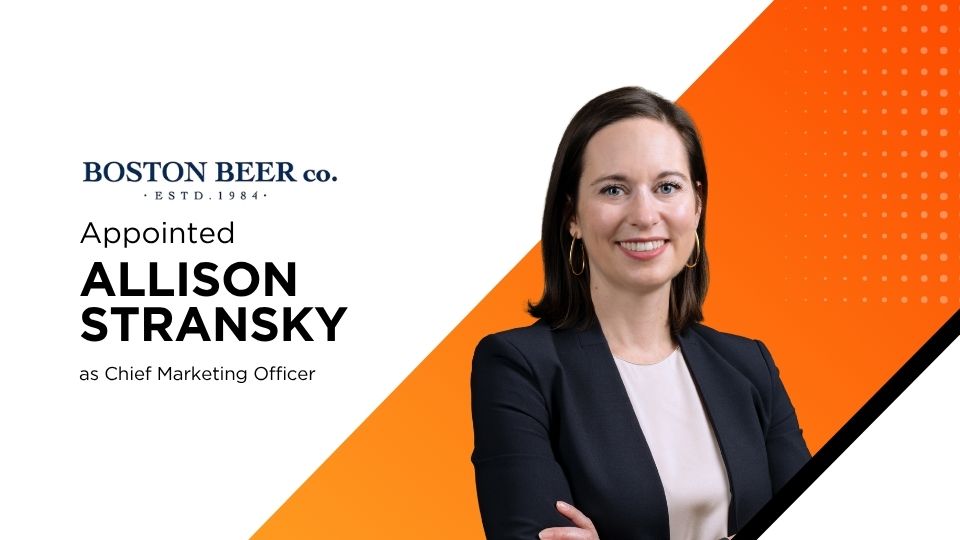
Boston Beer Appoints Allison Stransky as Chief Marketing Officer
marketing 9 Sep 2026
The Boston Beer Company has appointed Allison Stransky as chief marketing officer, effective October 12, 2026, bringing more than two decades of consumer brand-building and data-driven marketing experience to the company.
Stransky will lead marketing across Boston Beer's portfolio, which includes Samuel Adams, Dogfish Head, Twisted Tea, Sun Cruiser, Truly Hard Seltzer and Angry Orchard. Her responsibilities will span brand management, shopper marketing, connected commerce, digital and social media, integrated communications, media, sponsorships, experiential marketing, and consumer and business insights.
She will report to founder, brewer, chairman, president and CEO Jim Koch and COO Phil Hodges. Hodges has served as interim CMO during the company's search.
The appointment comes as consumer brands increasingly combine traditional brand building with data, digital media, AI and commerce capabilities. Stransky's background across consumer marketing and technology-oriented organizations places her experience at the intersection of these areas.
Market Landscape
Consumer marketing is increasingly moving toward integrated models in which brand strategy, digital engagement, data analytics and commerce operate together. Marketers are expected to build long-term brand equity while also demonstrating measurable performance across increasingly fragmented consumer touchpoints.
Stransky's current position at Samsung Electronics America includes responsibility for corporate marketing and communications, Big Data, AI-led transformation, sustainability and citizenship. Her work has included using Samsung's connected ecosystem to support growth, consumer engagement and AI-focused partnerships and campaigns.
Before Samsung, Stransky spent five years at Google, helping clients use data-driven insights to better understand consumers and improve advertising investment effectiveness. Earlier positions at L'Oréal, Unilever and Johnson & Johnson provided experience in consumer brand building, innovation and marketing.
Her career reflects the broader convergence between brand strategy, marketing technology, consumer insights and AI.
Strategic Outlook
Boston Beer's appointment of a marketing leader with experience spanning consumer brands, digital marketing and AI transformation signals the increasing importance of connecting creativity with data and technology.
The company's marketing organization covers a broad set of functions, from brand management and shopper marketing to media, social platforms, experiential activity and consumer insights. Coordinating these functions can help brands maintain a consistent identity while adapting campaigns to changing consumer behavior.
Connected commerce is another increasingly important component. The integration of marketing and commerce enables consumer brands to connect awareness and consideration with purchasing experiences, particularly as digital channels become more influential in product discovery.
Stransky's experience at Samsung also adds exposure to AI-led marketing transformation at a global technology company. At Boston Beer, that experience could be relevant as marketers assess how AI can support consumer insights, campaign development and personalized engagement while maintaining brand consistency.
The appointment therefore reflects a wider evolution in the CMO role: marketing leadership increasingly requires an understanding of creativity, technology, data and commercial performance rather than treating them as separate disciplines.
Top Insights
- Allison Stransky becomes Boston Beer's CMO on October 12, 2026.
- She brings more than 20 years of consumer marketing experience.
- Her responsibilities cover brand, shopper marketing, connected commerce, digital, social, media and experiential marketing.
- Stransky currently serves as VP and CMO of Samsung Electronics America.
- Her Samsung responsibilities include Big Data and AI-led transformation.
- She previously spent five years at Google working with data-driven advertising insights.
- Earlier roles included L'Oréal, Unilever and Johnson & Johnson.
Get in touch with our MarTech Experts.

DAS Technology Wins Five 2026 Dealers’ Choice Awards
marketing 9 Sep 2026
DAS Technology has received five 2026 Dealers’ Choice Awards from Auto Dealer Today, including three Diamond Awards, highlighting continued adoption of its digital marketing, customer data and AI-powered engagement technologies across automotive dealerships.
Its automotive retail brand, Digital Air Strike, received recognition in five categories: New Vehicle Leads, Reputation Management, Data Mining, Digital Marketing and Direct Marketing Sales. The company earned Diamond, or first-place, honors for New Vehicle Leads, Reputation Management and Data Mining, while receiving Platinum recognition for Digital Marketing and Gold for Direct Marketing Sales.
The latest awards bring DAS Technology's total Dealers’ Choice Awards tally to 53 across seven categories since 2013, according to the company.
The recognition comes as dealerships increasingly rely on digital platforms to manage consumer inquiries, online reputation, customer data and marketing campaigns. AI is also becoming a larger component of automotive retail workflows, particularly in search visibility, lead management and customer engagement.
Market Landscape
Automotive dealerships operate across multiple digital touchpoints, from inventory discovery and lead generation to reviews, email, text messaging and advertising. Managing these interactions effectively requires coordination between customer data and marketing technologies.
DAS Technology says its Digital Air Strike platform addresses several of these functions through solutions covering consumer engagement, advertising, inventory merchandising, reputation management and direct marketing.
The company's award-winning technologies include Smart Quote AI, Power AI Search and its Customer Data & Experience Platform (CDXP). Power AI Search focuses on AI-driven reputation and search visibility, reflecting a broader shift in automotive marketing as consumers increasingly use AI-powered search and recommendation experiences to research businesses.
Strategic Outlook
The Dealers’ Choice Awards are based on evaluations from dealers and dealership personnel who currently or recently worked with the providers. Participants assess providers based on product and service quality, customer support, value and whether they would recommend the company to another dealer.
That customer-based methodology provides a different signal from awards determined solely by industry panels. For automotive technology vendors, dealer adoption and satisfaction are increasingly important as dealerships evaluate platforms that can affect lead conversion, reputation and marketing efficiency.
DAS Technology's five-category recognition also illustrates the convergence of automotive marketing functions. Lead management, data mining, reputation management and digital marketing are increasingly interconnected rather than isolated activities.
The company said Power AI Search has received additional industry recognition in 2026, including Best New Product for Dealers at NADA, Best in Category for Automotive AI Solutions in the Globee Awards for Artificial Intelligence, and a Gold Stevie Award for Technology Breakthrough of the Year in the Advertising, Marketing & Public Relations Technology category.
The broader trend suggests that automotive marketers will continue looking for technologies capable of connecting customer data, AI, search visibility and engagement within dealership workflows.
Top Insights
- DAS Technology received five 2026 Dealers’ Choice Awards.
- Digital Air Strike earned three Diamond Awards for New Vehicle Leads, Reputation Management and Data Mining.
- The company also received Platinum for Digital Marketing and Gold for Direct Marketing Sales.
- DAS Technology says its total Dealers’ Choice Awards count has reached 53 since 2013.
- Power AI Search is positioned around AI-driven reputation and search visibility.
- The awards highlight the increasing overlap between automotive marketing, customer data and AI.
Get in touch with our MarTech Experts.

Blee Raises $27 Million to Expand AI Content Governance for Enterprises
marketing 9 Sep 2026
AI-first marketing compliance platform Blee has raised $20 million in Series A funding, bringing its total funding to $27 million as it expands technology designed to help enterprises govern the growing volume of AI-generated marketing content.
The Series A was co-led by Fin Capital and SMBC Fin Atlas Beyond Fund, with participation from Hannah Grey VC and National Bank of Canada. Existing investors including Y Combinator, Penny Jar Capital, Cardumen Capital and Treasury also participated.
The funding comes as enterprise marketing teams increasingly use artificial intelligence to automate content creation. Blee cited a Gartner survey in which marketing leaders expect the share of content automated by AI to increase from 16% in 2026 to 36% by 2028.
That growth creates a challenge for legal, compliance and brand teams responsible for reviewing customer-facing materials. As content is produced faster across advertising, social media, video, affiliate marketing and other channels, traditional manual approval processes can become a bottleneck.
Market Landscape
The expansion of generative AI is changing enterprise content operations by allowing marketing teams to create and modify material at significantly higher volumes. However, greater production capacity also increases the amount of content that requires regulatory, legal and brand oversight.
Blee's approach is to operate alongside existing content creation tools rather than replace them. Its platform uses AI to provide feedback across areas including regulatory requirements, compliance, legal considerations and brand standards before content enters formal review.
The company says legal and compliance teams using its platform have reduced average review times by up to 65%. The figure is a company-reported performance claim rather than an independent industry benchmark.
Strategic Outlook
Blee's platform is designed to cover the content lifecycle from submission and review through approval and comment cycles. It also maintains an audit trail intended to provide organizations with documentation of the review process.
The system extends beyond pre-publication workflows. After content goes live, Blee says it can monitor materials including influencer websites and social media for regulatory compliance and brand adherence.
This continuous approach reflects a broader shift in marketing compliance. As AI agents increasingly participate in content creation, organizations may need governance systems that operate continuously rather than relying exclusively on periodic manual reviews.
For enterprise marketing organizations, the issue is therefore not simply whether AI can create content. It is whether businesses can establish controls that allow that content to move quickly while maintaining legal, regulatory and brand standards.
Blee said its annual recurring revenue increased tenfold between June 2025 and June 2026 and that it works with companies across financial services, travel, life sciences and consumer brands. Customers named in the announcement include SoFi Technologies and Expedia Group.
The company plans to use the new capital to expand its content governance capabilities, enter additional industries and geographies, and increase adoption among enterprise legal, compliance, marketing and brand teams.
Top Insights
- Blee raised $20 million in Series A funding, bringing total funding to $27 million.
- The company focuses on AI-powered marketing compliance and content governance.
- Blee supports review workflows across legal, regulatory and brand requirements.
- Its platform can monitor published content as well as materials before publication.
- Blee reports a 65% reduction in average review times among legal and compliance users.
- The company says its ARR grew tenfold between June 2025 and June 2026.
- The funding will support product development and international and industry expansion.
Get in touch with our MarTech Experts.

Carlos Cortinas Joins Thunderly Marketing as Chief Strategy Officer
marketing 9 Sep 2026
Franchise marketing agency Thunderly Marketing has appointed advertising and creative strategy veteran Carlos Cortinas as its chief strategy officer, adding a dedicated strategic leadership role as brands adapt to changes in search, media and consumer discovery.
The newly created position is intended to strengthen the strategic foundation behind client marketing programs, with particular attention to brand visibility in an increasingly zero-click search environment.
Cortinas joins Thunderly after approximately 15 years leading creative strategy at advertising agencies, where he worked on campaigns for global brands. His appointment adds experience across creative strategy and marketing communications to Thunderly's franchise-focused operations.
The move reflects a broader challenge for franchise marketers. Consumers increasingly encounter brands through search results, social platforms, AI-generated answers and other digital touchpoints before visiting a company's website. As a result, maintaining a consistent brand position across these environments is becoming more important.
Market Landscape
Franchise brands operate across multiple locations while needing to maintain consistency in messaging, positioning and customer experience. Traditional marketing channels remain relevant, but search behavior is changing as consumers increasingly use AI-powered search experiences and large language models to discover and evaluate businesses.
The shift toward zero-click search also changes how visibility is measured. A consumer may encounter a brand, answer or recommendation without clicking through to the company's website. This makes brand authority, structured information, topical relevance and consistent messaging increasingly important components of digital marketing strategy.
For franchise organizations, the challenge can be more complex because national brand positioning must coexist with local marketing needs. A clear strategic foundation can help align those layers rather than treating every channel or location as a separate marketing activity.
Strategic Outlook
Thunderly recently introduced its proprietary Thunderly AIM Model (Amplified Integrated Marketing) in response to the growth of AI-generated search and LLM-based discovery.
According to the company, the model is designed to provide a flexible approach for maintaining control over brand messaging as the marketing environment evolves. Cortinas' appointment adds a senior strategy role to that broader effort.
His focus is centered on establishing a stronger point of view across marketing communications rather than simply expanding the number of channels a brand uses.
That approach reflects a wider change in modern marketing strategy. As brands distribute content across search, social, advertising and AI-powered discovery platforms, channel expansion alone does not necessarily create stronger visibility. Consistent positioning and differentiated messaging can become important inputs across those environments.
For franchise marketers, the strategic question is increasingly how to make a brand recognizable and relevant wherever consumers encounter it, while preserving enough flexibility for local markets.
Top Insights
- Carlos Cortinas has joined Thunderly Marketing as chief strategy officer.
- The newly created role focuses on strengthening strategic marketing foundations.
- Cortinas brings around 15 years of creative strategy experience.
- Thunderly is responding to changes in AI-powered search and zero-click discovery.
- Its AIM Model is designed around integrated marketing and adaptable brand messaging.
- Franchise brands face the additional challenge of balancing national positioning with local marketing needs.
Get in touch with our MarTech Experts.

FouAnalytics Launches Practitioners Spotlight to Highlight Hands-On Digital Marketing Expertise
marketing 9 Sep 2026
FouAnalytics has launched Practitioners Spotlight, a weekly LinkedIn profile series designed to recognize professionals whose hands-on work contributes to digital marketing, advertising and adtech.
The initiative moves away from conventional influencer rankings and instead focuses on the practitioners working directly with campaigns, data, measurement and marketing decisions. FouAnalytics founder Dr. Augustine Fou said the series was created because there are more practitioners deserving recognition than can reasonably fit into a traditional “Top 100” list.
Each Spotlight profile will introduce an individual, explain the work they perform and examine the problems they help solve. The series will also highlight lessons that other marketing professionals can apply to their own work.
The launch comes as artificial intelligence becomes increasingly integrated into everyday marketing workflows. AI tools can generate reports, summarize campaign performance and produce recommendations at increasing speed, but the ability to assess whether those outputs are accurate remains a critical part of marketing operations.
Market Landscape
Digital marketing has become increasingly dependent on data-driven decision-making, spanning advertising platforms, analytics, attribution, audience measurement and campaign optimization. At the same time, AI is adding another layer to these workflows by automating analysis and generating recommendations.
That shift creates a growing distinction between producing an answer and determining whether the answer is useful. Experienced practitioners can identify unusual metrics, question inconsistent results and investigate recommendations that appear credible but may require additional validation.
FouAnalytics is positioning its Spotlight series around that practical expertise. Rather than emphasizing job titles, audience size or industry visibility, the profiles will examine how professionals approach real marketing problems and use data to make decisions.
Strategic Outlook
The initiative extends the company's FouAnalytics Practitioners Newsletter, which focuses on real campaign data, practical analysis and insights drawn from hands-on digital marketing experience.
Publishing the profiles through LinkedIn also reflects how professional knowledge is increasingly distributed through social platforms. Short, practitioner-focused content can provide examples of marketing problems and solutions while creating visibility for professionals who may not have large online audiences.
The emphasis on specific examples could become particularly relevant as marketers adopt AI-assisted workflows. As automated systems take on more analytical and repetitive tasks, practitioners may increasingly be differentiated by their ability to validate information, understand context and translate data into appropriate actions.
For marketing teams, this suggests that AI adoption does not necessarily reduce the value of experience. Instead, practical expertise can become an important layer of oversight around automated analysis and recommendations.
Top Insights
- FouAnalytics has introduced a weekly Practitioners Spotlight series on LinkedIn.
- The series focuses on hands-on professionals across digital marketing, advertising and adtech.
- Profiles will prioritize practical work over titles, follower counts and generic career advice.
- AI-generated reports and recommendations increase the importance of human validation.
- The initiative builds on the FouAnalytics Practitioners Newsletter.
- Each profile is intended to provide examples and lessons other practitioners can apply.
Get in touch with our MarTech Experts.

SMARTIES Philippines 2026 Finalists Highlight Hyper-Local Marketing Innovation
marketing 9 Sep 2026
The Marketing + Media Alliance (MMA) has announced the finalists for the SMARTIES Philippines 2026 awards, highlighting campaigns that combine local cultural understanding, emerging technology and measurable business outcomes.
This year's shortlist reflects how Philippine marketers are adapting to changing consumer behavior through social-first strategies and integrated digital ecosystems. Among the themes identified by MMA are shoppertainment, digital wallet integration and purpose-led campaigns built around bayanihan, the Filipino concept of communal unity.
The finalists illustrate a marketing environment in which cultural relevance and technology increasingly operate together. Rather than treating innovation as a standalone technology exercise, the shortlisted campaigns demonstrate how emerging tools can be applied to audience engagement, commerce and brand growth.
Market Landscape
The Philippine marketing market is becoming increasingly shaped by mobile-first and social-first consumer behavior. Brands are connecting content, commerce and payments across digital touchpoints, creating more continuous customer journeys.
Shoppertainment is one example of this convergence, combining entertainment and shopping experiences to reduce the distance between discovery and purchase. Digital wallets similarly provide brands with opportunities to connect marketing engagement with transaction-oriented experiences.
At the same time, purpose-led marketing remains part of the competitive landscape. The SMARTIES finalists' emphasis on bayanihan indicates how local cultural values can become a strategic component of campaigns rather than simply a creative theme.
Strategic Outlook
The 2026 SMARTIES framework evaluates campaigns across four areas: Purpose Driven Marketing, Impact Marketing, Media & Growth, and Creative & Innovation Impact. The categories reflect the growing expectation that successful campaigns demonstrate both creative strength and commercial or societal relevance.
Purpose Driven Marketing covers campaigns designed to generate meaningful cultural or societal impact, including sustainability, diversity and inclusion initiatives. Impact Marketing focuses on measurable business outcomes and stronger brand relationships.
Media & Growth evaluates integrated media strategies and audience development, while Creative & Innovation Impact recognizes campaigns using creativity, data and emerging technology to create new forms of brand engagement.
The judging process also places significant emphasis on business impact. Submissions first undergo review by a qualifying jury of senior advertising professionals before a final jury made up exclusively of marketers, including CEOs and CMOs, evaluates the campaigns.
This structure highlights an important shift in marketing awards: innovation increasingly needs to demonstrate what it changed, not simply what technology or creative execution it used.
For brands operating in Southeast Asian markets, the Philippine finalists also demonstrate the potential value of combining global marketing capabilities with highly localized cultural insights.
Top Insights
- MMA has announced the SMARTIES Philippines 2026 finalists.
- Shortlisted campaigns combine cultural insights with technology and business objectives.
- Shoppertainment and digital wallet integration are among the highlighted themes.
- Purpose-led marketing draws on the Filipino value of bayanihan.
- SMARTIES evaluates Purpose Driven Marketing, Impact Marketing, Media & Growth, and Creative & Innovation Impact.
- Final judging focuses on measurable business impact.
Get in touch with our MarTech Experts.

Solera Expands AI Sales Coaching for Automotive Dealerships
marketing 9 Sep 2026
Solera is expanding its artificial intelligence capabilities for automotive dealerships with AI Sales Coach, a DealerSocket CRM feature designed to turn sales-performance data into daily, individualized coaching recommendations.
The company says the tool continuously analyzes sales performance across dealership teams and locations, assigns sales representatives performance tiers and generates coaching notes that managers can access from the CRM dashboard. The launch reflects a broader movement in automotive retail toward embedding AI directly into customer relationship management and sales workflows rather than using analytics as a separate reporting layer.
AI Sales Coach follows Solera's earlier introduction of conversational AI for lead response and AI-powered lead scoring in 2026. The three capabilities are positioned as components of the company's Solera AI Engine, which connects dealership data and workflows across its technology portfolio.
Market Landscape
Automotive dealerships have access to increasing amounts of customer and sales data, but converting that information into timely action remains a challenge. CRM systems can contain information about leads, interactions and sales activity, while managers must still determine which representatives require attention and what coaching intervention may be appropriate.
AI-based sales tools are increasingly addressing that gap by moving from descriptive reporting toward recommendations and workflow automation. Lead scoring can prioritize opportunities, conversational AI can support response processes, and performance coaching can focus managers on employee development.
The approach also reflects the continuing convergence of automotive retail technology and marketing technology. Lead generation, follow-up, CRM engagement and sales performance are closely connected, making data continuity increasingly important across the customer journey.
Strategic Outlook
Solera says AI Sales Coach identifies coaching opportunities and provides targeted guidance within DealerSocket CRM. The intended outcome is to make sales coaching more consistent and less dependent on managers manually reviewing fragmented reports.
The company's broader strategy is based on a shared data foundation. Solera says its AI Engine connects dealership information and orchestrates workflows across products, with AI Sales Coach using the same connected customer record as other capabilities.
That model could offer an advantage over disconnected point solutions if signals from lead activity, customer interactions and sales performance can be combined effectively. It also creates a potential feedback loop in which additional data improves the usefulness of subsequent recommendations.
However, AI-generated coaching still requires managerial judgment. Performance data can identify patterns, but managers remain responsible for understanding context, setting expectations and determining how individual employees should be supported.
For automotive retailers, the more significant development may therefore be the integration of AI into everyday dealership operations rather than AI as a standalone analytics product.
Top Insights
- Solera introduced AI Sales Coach within DealerSocket CRM.
- The tool analyzes sales performance and identifies coaching opportunities.
- Managers receive individualized coaching guidance through the CRM dashboard.
- AI Sales Coach follows Solera's AI lead response and lead-scoring capabilities.
- The capabilities operate on the company's Solera AI Engine and connected data foundation.
- The strategy connects sales performance, CRM data and AI-driven decision support.
Get in touch with our MarTech Experts.

TechDigital Labs Expands Enterprise SEO Services for Large Websites and SaaS
marketing 9 Sep 2026
TechDigital Labs has introduced an expanded Enterprise SEO Services offering for large websites, SaaS businesses, e-commerce companies and organizations managing multiple digital properties. The program focuses on technical SEO, crawling and indexing, website architecture, internal linking, Core Web Vitals and enterprise content management.
The move comes as organizations with hundreds or thousands of pages face increasingly complex challenges in maintaining consistent organic search performance. Unlike smaller websites, enterprise properties can have numerous product, service, location, brand and educational pages, meaning a structural issue can potentially affect large groups of URLs.
TechDigital Labs says its approach is designed to identify these issues and establish priorities for long-term search performance across large and multi-site environments.
Market Landscape
Enterprise SEO increasingly involves managing search infrastructure rather than optimizing individual pages in isolation. Google's documentation recommends that websites maintain logical structures, ensure important pages are accessible to crawlers and use internal links to help search engines understand relationships between pages.
For SaaS businesses, this can involve managing product, solution, comparison and educational content. E-commerce organizations face additional complexity across product catalogs, categories, filters and other navigational elements. International companies may also need to coordinate SEO across markets, languages and domains.
Technical performance remains another consideration. Google says Core Web Vitals measure loading performance, interactivity and visual stability and are used by its systems as part of evaluating page experience.
Strategic Outlook
TechDigital Labs' updated service covers enterprise website audits, crawl and indexing analysis, duplicate-content reviews, page-speed assessments, mobile functionality, structured data and internal-linking structures. It also evaluates content quality, relevance and alignment with search intent.
The company says its process includes analysis, issue identification, prioritization, recommendations, implementation monitoring and continuous improvement. For organizations with multiple properties, the strategy can extend to multi-site and multi-brand SEO, international SEO and SEO migration management.
The emphasis on governance is particularly relevant to large organizations where SEO responsibilities can span marketing, content, development and business teams. Establishing common processes can help prevent technical and content changes from creating inconsistencies across a large digital ecosystem.
TechDigital Labs is also examining changing search behavior and AI-driven search visibility. This reflects an emerging consideration for enterprise marketers: maintaining conventional search visibility while ensuring content is structured and useful enough to be surfaced in newer generative search experiences.
However, AI-search optimization does not replace fundamental technical SEO. Crawlability, indexing, useful content, site architecture and clear information remain foundational requirements for large websites.
Top Insights
- TechDigital Labs has expanded its Enterprise SEO Services for large digital properties.
- The offering targets enterprise websites, SaaS, e-commerce and multi-site organizations.
- Technical SEO, indexing, architecture and internal linking are central components.
- Core Web Vitals and mobile functionality are included in the technical assessment.
- The strategy supports multi-brand, international and multi-site SEO requirements.
- The company is also exploring enterprise visibility across AI-driven search.
Get in touch with our MarTech Experts.
Page 56 of 719
Most Recent

On-Target! Wins 2026 BBB Award for Excellence in Houston
EIN Presswire