News

Cadent Appoints New CPO and Marketing Chief as Predictive Advertising Demand Grows
advertising 16 Jan 2026
Cadent is bolstering its executive bench as demand accelerates for predictive, full-funnel advertising solutions. The company has appointed Kim Tingler as Chief People Officer and Daniella Krieger as Senior Vice President of Marketing, signaling a dual focus on scaling its organization and sharpening its go-to-market execution.
The leadership moves come as advertisers and agencies increasingly look for platforms that can unify data, forecasting, and activation across channels—while also demanding clearer differentiation in an ad tech market crowded with AI claims.
“As Cadent enters its next phase of growth, strengthening both our people strategy and our go-to-market leadership is essential,” said CEO Nick Troiano. “Kim brings deep experience building cultures that help organizations grow with intention, while Daniella has a proven ability to translate complex technology into clear, compelling value for the market.”
Why these roles matter now
Cadent operates at the intersection of predictive analytics, media planning, and activation—areas seeing renewed attention as brands push for better forecasting, outcome-based buying, and full-funnel measurement. Scaling that kind of platform requires more than product innovation; it demands organizational maturity and sharper storytelling.
The appointment of a Chief People Officer reflects Cadent’s recognition that talent, structure, and culture are strategic assets, not back-office concerns. At the same time, bringing in a senior marketing leader with deep ad tech experience suggests the company is preparing for a more competitive phase of market education and brand differentiation.
Kim Tingler: scaling culture with intention
Tingler joins Cadent with more than 15 years of experience leading people strategy and organizational transformation across media and technology companies. Most recently, she served as SVP of People and Culture at Rokt, where she set the agenda for the people function during a period of growth. Before that, she held senior HR leadership roles at A+E Networks and spent over a decade at NBCUniversal, supporting advertising sales and marketing teams.
Her background is particularly relevant for an ad tech company navigating growth without losing focus. High-growth platforms often struggle to maintain performance and engagement as teams scale quickly—a challenge Tingler has spent much of her career addressing.
In her role as CPO, Tingler will focus on ensuring Cadent’s organization is structured to support both business expansion and employee success.
“Building an organization that is intentional about how it develops, supports, and empowers its people is critical,” Tingler said. “My focus is making sure our leaders, teams, and culture evolve in step with the business.”
Daniella Krieger: clarifying Cadent’s market narrative
On the go-to-market side, Krieger brings more than 17 years of experience across brand, product, and GTM marketing in ad tech and digital media. She joins Cadent from MiQ, where she served as SVP of U.S. Marketing and led the go-to-market strategy for MiQ Sigma, the company’s AI-powered programmatic advertising platform.
At Cadent, Krieger will oversee brand and product marketing, with a mandate to clearly articulate the value of Cadent’s unified, predictive platform to advertisers, agencies, and partners.
That clarity is increasingly important. As AI becomes ubiquitous in advertising technology, differentiation is less about whether a platform uses AI and more about how it delivers measurable outcomes.
“Innovation, especially AI, is transforming advertising at unprecedented speed,” Krieger said. “But it’s also made differentiation more critical. I’m excited to help bring a unified platform to market that cuts through complexity and clearly communicates Cadent’s strengths.”
A broader signal for AdTech and MarTech
Cadent’s leadership changes reflect a wider trend across AdTech and MarTech: companies are investing just as heavily in people and positioning as they are in technology. Predictive advertising, full-funnel measurement, and AI-driven optimization are no longer emerging concepts—they’re expected capabilities.
As adoption accelerates, vendors must scale responsibly, maintain trust with clients, and communicate value in a way that resonates with both technical and business stakeholders. Cadent’s decision to strengthen both its people leadership and marketing leadership suggests it’s preparing for that next stage of competition.
For advertisers and agencies evaluating predictive advertising platforms, the move is a reminder that execution matters as much as innovation. The platforms that win will be those that combine advanced technology with strong teams, clear narratives, and the operational maturity to deliver consistently at scale.
Get in touch with our MarTech Experts.
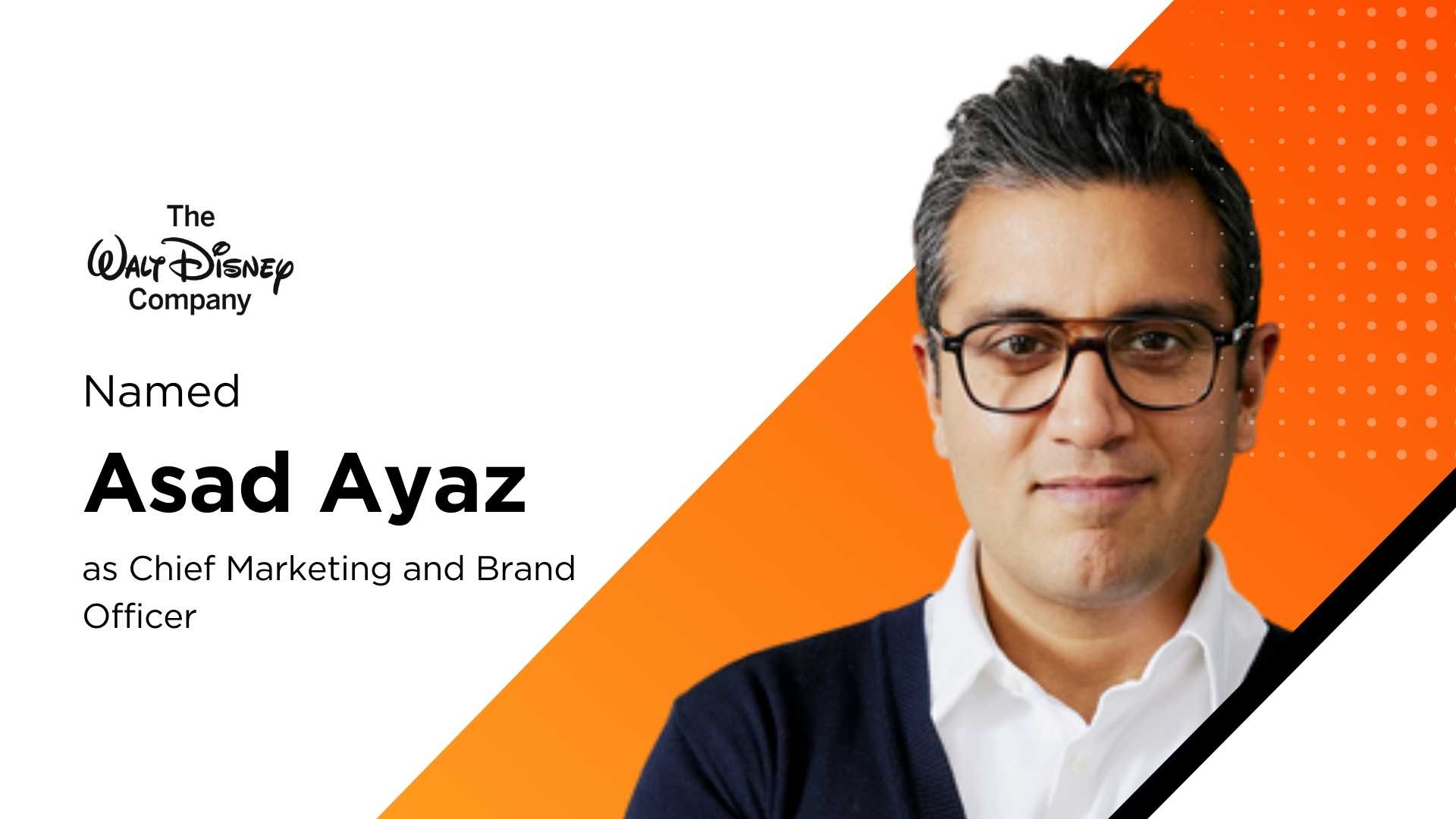
Disney Creates Enterprise Marketing Organization, Names Asad Ayaz Chief Marketing and Brand Officer
customer experience management 16 Jan 2026
The Walt Disney Company is reshaping how it markets itself to the world. The media and entertainment giant has announced the creation of a new enterprise-wide marketing and brand organization, a move designed to bring tighter alignment across its sprawling businesses and deliver a more consistent, connected experience for consumers. To lead the effort, Disney has named longtime executive Asad Ayaz as its first Chief Marketing and Brand Officer.
The new role formalizes something Disney has increasingly needed as its portfolio has expanded across studios, streaming, parks, sports, and consumer products: a single executive with authority over brand coherence and marketing strategy at the company level.
Why Disney is centralizing marketing now
Disney’s businesses have never been more diverse—or more interconnected. From blockbuster franchises and Disney+ originals to theme parks, cruises, ESPN, and global consumer products, the company’s brands touch audiences across dozens of platforms and experiences.
Until now, much of that marketing muscle has lived within individual segments. The new enterprise marketing organization is meant to harness that collective strength, aligning teams and capabilities to ensure campaigns feel connected, brand standards remain consistent, and audiences can move seamlessly between Disney experiences.
CEO Bob Iger framed the move as both a brand and consumer imperative.
“As our businesses have evolved, it’s clear that we need a company-wide role that ensures brand consistency and allows consumers today to seamlessly interact with our products and experiences,” Iger said, calling the new CMO and brand role “critical for this moment.”
For marketers watching the space, the message is clear: as brands scale across channels and business models, decentralized marketing structures can become a liability.
Asad Ayaz’s expanded mandate
Ayaz steps into the role with more than two decades at Disney and deep familiarity with its most visible brands. He previously spent eight years as President of Marketing for The Walt Disney Studios, where he oversaw campaigns for theatrical releases across Disney, Pixar, Marvel, Lucasfilm, and 20th Century Studios. He also led marketing for Disney+ during its growth into a global streaming platform.
In 2023, Ayaz was named Disney’s first-ever Chief Brand Officer, taking responsibility for company-wide brand stewardship, alliances, and major events. The new appointment expands that remit significantly—placing enterprise marketing execution alongside brand governance under one leader.
Disney’s segment leaders were explicit about why Ayaz was chosen.
“Asad is an exceptional creative leader with strong strategic and operational prowess and deep experience across Disney and its brands,” said Disney Entertainment co-chairs Alan Bergman and Dana Walden, Disney Experiences chairman Josh D’Amaro, and ESPN chairman Jimmy Pitaro in a joint statement.
That combination of creativity and operational scale is essential for a role that must balance local flexibility with global consistency.
What the new organization will change
According to Disney, the unified marketing group will connect shared capabilities and modern marketing tools across the company, improving continuity and agility. While specifics were not disclosed, the implications are significant.
For a company like Disney, this could mean:
-
More coordinated global launches across film, streaming, parks, and consumer products
-
Shared data, insights, and marketing technology across segments
-
Faster execution as teams reuse frameworks and assets rather than rebuilding them
-
Stronger brand governance as franchises expand into new formats and regions
Ayaz will report directly to Bob Iger as Chief Marketing and Brand Officer, while also working closely with Disney’s segment chairs to lead marketing efforts across business units—a dual-reporting structure that underscores both central authority and segment accountability.
A broader signal for enterprise marketing
Disney’s move mirrors a growing trend among global brands: elevating marketing and brand leadership to the enterprise level. As customer journeys span platforms, devices, and experiences, fragmented marketing strategies can erode brand equity and dilute impact.
In an era of streaming competition, experiential commerce, and IP-driven ecosystems, Disney’s brand is one of its most valuable assets. Centralizing marketing around that asset suggests the company is preparing for a more integrated future—one where franchises, experiences, and distribution channels are marketed as parts of a single narrative.
For MarTech and marketing leaders, the takeaway is timely. Technology, data, and AI have made cross-channel execution possible—but organizational alignment is what ultimately determines whether brands can deliver cohesive experiences at scale.
By appointing a Chief Marketing and Brand Officer and backing the role with an enterprise-wide organization, Disney is betting that brand consistency and connected marketing will be as critical to growth as content itself.
Get in touch with our MarTech Experts.

Calabrio Launches Omni Agent Intelligence to Unify Quality Measurement Across Human and AI Agents
customer experience management 16 Jan 2026
As AI agents become a permanent fixture in customer service operations, Calabrio is betting that quality management can no longer live inside platform silos.
The workforce and conversation intelligence company has launched Calabrio Omni Agent Intelligence, a new capability embedded within Calabrio ONE that provides a single, vendor-agnostic view of quality and performance across both human agents and AI agents. The solution is already available to Calabrio ONE customers and supports all major CCaaS, CRM, ITSM, and AI agent platforms.
Why It Matters: AI Has Outpaced Quality Governance
Contact centers today operate with a blended workforce—human agents, AI agents, and AI assistants—spread across multiple systems. But performance and quality are often measured separately, depending on the platform.
That fragmented approach creates blind spots.
Leaders may see how an AI bot performs in isolation, but not how it impacts human workload, sentiment, handle times, or customer outcomes across the full journey. According to Calabrio, that gap limits accountability and makes it difficult to understand whether automation is actually improving CX—or quietly degrading it.
One Quality Framework Across the Entire Stack
Omni Agent Intelligence acts as a unified AI quality layer, standardizing interaction data from disparate platforms into a single view of agent performance. Unlike platform-specific analytics, it applies a shared quality framework across both AI and human agents, while still allowing scoring criteria to be tailored by agent type.
This enables organizations to:
-
Compare AI and human agent performance consistently
-
Identify weak handoffs between automation and people
-
Detect underperforming AI agents early
-
Measure how automation affects sentiment, AHT, and outcomes
“Customer service can’t keep treating people and AI as separate worlds,” said Calabrio CEO Dave Rhodes. “Omni Agent Intelligence lets leaders see how teams and technology actually work together—and make decisions based on real insight instead of guesswork.”
Built for Constantly Changing Tech Stacks
As enterprises experiment with AI agents from multiple vendors—and frequently change CCaaS platforms—quality programs often break or require expensive custom BI work.
Calabrio positions Omni Agent Intelligence as a more durable alternative. Delivered within Calabrio ONE, it functions as a quality control tower, maintaining consistent measurement even as platforms are added, replaced, or upgraded.
For QM and CX teams, that means governance stays intact without rebuilding dashboards or re-engineering evaluation models every time the stack changes.
Key Capabilities at a Glance
Calabrio highlights several operational benefits:
-
Day-one visibility: Out-of-the-box views of AI and human agents, including sentiment, QM scores, trending topics, and AHT
-
Improved CX: Better detection of poor automation and handoff failures before they escalate
-
Stronger AI ROI measurement: Clear insight into how AI agents impact workload, customer sentiment, and efficiency
-
Faster decisions: One consistent framework replaces conflicting vendor-specific reports
-
Reduced risk: Unified Auto QM helps surface compliance and performance issues early
-
Future-proof flexibility: Quality programs remain stable even as platforms evolve
The Bigger Picture
As AI agents move from pilot projects to frontline roles, enterprises are under pressure to prove they work—not just technically, but operationally and experientially.
Calabrio’s Omni Agent Intelligence reflects a broader industry shift: AI adoption without governance is no longer acceptable. The next phase of customer service innovation will be defined not by how many bots a company deploys, but by how clearly it can measure their impact.
Get in touch with our MarTech Experts.

CDMO Marketers Double Down on SEO, AI, and Hybrid Teams in 2026, New Report Finds
artificial intelligence 16 Jan 2026
Marketing teams inside the U.S. contract development and manufacturing organization (CDMO) sector are entering 2026 with cautious optimism—and a much heavier reliance on data, AI, and outsourced expertise.
That’s the takeaway from Altitude Marketing’s 2026 CDMO Marketing Trends Report, a quantitative study based on survey responses from 149 CDMO marketing leaders. The report benchmarks how life sciences marketers are reshaping go-to-market strategies amid pricing pressure, longer sales cycles, and accelerating technological change.
Growth, But Not a Free-for-All
Despite ongoing market uncertainty, CDMO marketing teams are expanding. Nearly 80% of respondents expect headcount growth in 2026, and a similar share anticipates budget increases.
But the data suggests that growth will be disciplined rather than exuberant. Instead of building large in-house teams, CDMOs are leaning toward hybrid resourcing models. Roughly three-quarters of respondents plan to increase their use of external agencies, signaling a preference for flexibility and specialized expertise over permanent staff expansion.
SEO and AI Search Overtake Traditional Channels
The report highlights a decisive shift away from legacy marketing tactics. Organic SEO and AI-driven search emerged as the most effective sources of qualified leads in 2025, outperforming trade shows, print advertising, and even paid digital media.
That momentum is expected to continue. Respondents say these inbound, content-led channels will command the largest share of marketing investment in 2026, reflecting how CDMO buyers increasingly research partners long before engaging sales teams.
For an industry built on trust, regulatory rigor, and long-term partnerships, educational content and discoverability appear to be winning out over splashy top-of-funnel tactics.
AI Moves From Experiment to Infrastructure
AI adoption among CDMO marketers is no longer tentative. According to the report, 70% of respondents now use AI tools daily, primarily for data analysis, information discovery, and content repurposing.
The efficiency gains are tangible. Most respondents estimate saving five to ten hours per week, underscoring that AI has moved from pilot projects into day-to-day operations.
Rather than replacing marketers, AI is functioning as a force multiplier—helping lean teams execute more sophisticated strategies without proportional increases in headcount.
Insight for Teams Planning 2026 Budgets
Altitude Marketing positions the report as a practical planning tool for marketing leaders navigating steady—but constrained—growth.
“Marketing leaders at CDMOs are being asked to do more with steady, not unlimited, growth,” said Adam Smartschan, chief strategy officer at Altitude Marketing. “This research gives teams a clear picture of what their peers are prioritizing, where budgets are moving, and which channels and tools are actually delivering results.”
Key findings from the report will be unpacked during a Contract Pharma webinar on January 29 at 11:00 a.m. ET, featuring Smartschan alongside John Boogard, Senior Director of Global Marketing and Product Strategies at ARx. The session will focus on translating benchmark data into actionable 2026 marketing plans.
The Bigger Picture
The CDMO marketing playbook is evolving quickly. Growth is back on the table—but it’s being fueled by SEO, AI-powered efficiency, and flexible operating models, not bloated teams or legacy spend.
For CDMOs competing in an increasingly crowded and global market, the message is clear: smarter marketing, not louder marketing, will define 2026.
Get in touch with our MarTech Experts.

RingCentral Named an IDC MarketScape Leader for AI-Driven Contact Center Workforce Management
artificial intelligence 15 Jan 2026
RingCentral is doubling down on its AI-first vision for contact centers—and analysts are taking notice. The cloud communications giant has been named a Leader in the IDC MarketScape: Worldwide AI-Enabled Contact Center Workforce Engagement Management 2025–2026, a recognition that underscores how seriously the market is taking AI’s role beyond chatbots and agent assist tools.
At the center of this recognition is RingWEM, RingCentral’s workforce engagement management suite, which is built natively into its AI-powered contact center platform, RingCX. Unlike many workforce tools that still rely on bolt-on integrations, RingWEM is designed as a core layer of the platform, handling forecasting, scheduling, quality management, and performance analytics in one cloud-native system.
Why IDC’s Call Matters
IDC’s MarketScape doesn’t just look at feature checklists. Its evaluations focus on how well vendors help organizations solve real operational problems—especially at scale. According to IDC Research Director Lou Reinemann, RingCentral stands out for enterprises with global footprints, hybrid workforces, and geographically distributed teams.
That’s a key point. Workforce engagement management has become significantly more complex as contact centers move away from centralized, on-premise models. Predicting demand across regions, managing agent performance remotely, and maintaining service levels while controlling labor costs are now table stakes. IDC’s assessment suggests RingCentral is meeting those demands with an architecture designed for modern, distributed operations—not legacy call center assumptions.
AI Moves From the Agent Desktop to the Ops Room
Much of the recent hype around AI in contact centers has focused on agent-facing tools: real-time prompts, automated summaries, and sentiment analysis. RingCentral’s strategy goes further upstream.
RingWEM applies AI to operational planning itself, using continuous forecasting models that adapt to changing demand patterns without heavy manual intervention. Instead of supervisors relying on static schedules and historical averages, the system dynamically adjusts staffing needs based on real-time and predictive inputs.
This shift has practical implications:
-
Forecasting becomes adaptive, not periodic
-
Scheduling reflects actual demand, not best guesses
-
Quality management scales automatically, using AI-driven monitoring rather than random sampling
-
Supervisors focus more on coaching, less on spreadsheets
In short, AI becomes part of how contact centers are run, not just how agents are assisted.
Native Integration as a Competitive Advantage
One of RingCentral’s most notable differentiators is that RingWEM is natively embedded within RingCX, rather than stitched together from multiple third-party tools. This matters more than it sounds.
Many enterprises today operate with fragmented contact center stacks—one vendor for routing, another for workforce management, another for quality assurance, and yet another for analytics. Each handoff introduces latency, data gaps, and administrative overhead.
By unifying forecasting, scheduling, screen recording, performance analytics, and quality management in a single platform, RingCentral is positioning RingCX as a system of record for both agent experience and customer experience. For large organizations, that can translate into faster decision-making, lower operational complexity, and more consistent service delivery across regions.
Labor Costs, Meet Automation
Labor remains the largest cost center for most contact operations. RingCentral’s pitch—and IDC’s validation—hinges on using AI to make workforce decisions more precise and less reactive.
AI-driven automation helps organizations:
-
Reduce overstaffing during low-demand periods
-
Prevent understaffing that hurts customer satisfaction
-
Maintain consistent service levels without inflating headcount
-
Align agent experience with performance outcomes
This approach reflects a broader industry trend: AI is increasingly being used to optimize economics, not just interactions. Vendors that can tie AI investments directly to cost control and productivity gains are gaining favor with enterprise buyers.
Executive Perspective: Practical AI, Not Flashy AI
RingCentral executives are framing this recognition as validation of a pragmatic approach to AI. According to Jim Dvorkin, SVP of Customer Experience Products, the company’s goal isn’t to showcase AI for its own sake, but to deliver “practical intelligence” that improves conversations and operational resilience.
That emphasis aligns with where many enterprise buyers are today. After years of experimentation, organizations are now asking harder questions: Does this AI reduce effort? Does it improve outcomes? Does it scale without adding complexity?
IDC’s Leader designation suggests RingCentral is answering “yes” often enough to stand out in a crowded market.
Market Context: Workforce Engagement Is Having a Moment
The timing of this recognition is telling. Workforce engagement management is emerging as one of the fastest-evolving segments of the contact center market, fueled by:
-
Hybrid and remote work becoming permanent
-
Rising customer expectations for speed and consistency
-
Pressure to do more with leaner teams
-
Maturation of AI models capable of real-time and predictive analysis
Vendors that treat WEM as a secondary add-on are increasingly at risk of falling behind. RingCentral’s decision to make RingWEM a core pillar of RingCX positions it well against rivals that still rely on fragmented ecosystems.
The Bigger Picture
Being named a Leader in the IDC MarketScape doesn’t guarantee market dominance—but it does signal credibility. For enterprises evaluating long-term contact center platforms, especially those with global operations, RingCentral’s AI-driven, integrated approach to workforce engagement is likely to resonate.
More broadly, this recognition highlights a shift in how the industry defines “AI-powered contact centers.” It’s no longer just about smarter agents. It’s about smarter planning, smarter staffing, and smarter use of human talent at scale.
Get in touch with our MarTech Experts.

Ketch Launches Opt-Out Sync to Enforce ‘Do Not Sell’ Across the Entire Data Stack
technology 15 Jan 2026
As U.S. privacy enforcement sharpens, consent banners alone are no longer enough—and regulators are making that clear. Ketch, the AI-powered privacy management company, has announced the general availability of Ketch Opt-Out Sync, a new capability designed to finally close one of the most persistent gaps in enterprise privacy operations: fragmented opt-out enforcement.
Opt-Out Sync extends Ketch’s Identity Sync framework, giving organizations a way to honor “Do Not Sell or Share” requests consistently across browsers, devices, and backend systems—without forcing consumers through repetitive forms or identity verification hoops.
Regulators Are Raising the Bar
Recent settlements involving companies such as Honda, Healthline Media, and Jam City have sent a strong signal from U.S. regulators: opt-out experiences must be frictionless, transparent, and comprehensive. Partial compliance—where some systems honor opt-outs while others quietly continue data sharing—is increasingly viewed as unacceptable.
Yet that partial enforcement remains common. Many organizations still rely on disconnected mechanisms that don’t talk to each other. A user may opt out via a consent banner, stopping browser-based tracking, while their data continues to circulate in CRM or email systems. In other cases, a webform opt-out flags backend records tied to an email address, but cookies, pixels, and ad trackers keep firing.
The result is growing compliance risk—and a failure to fully respect consumer intent.
From Front-End Signals to Back-End Enforcement
Ketch Opt-Out Sync is designed to eliminate these blind spots by connecting consent banners, DSR webforms, and backend systems into a single automated workflow. Built on Identity Sync, the system recognizes users across logged-in and logged-out states and applies opt-out choices everywhere data flows.
Crucially, this happens without requiring consumers to repeatedly identify themselves or submit multiple requests. One action is meant to govern all downstream use of their data.
What’s New Under the Hood
Ketch positions Opt-Out Sync as a shift from surface-level compliance to operational enforcement. Key capabilities include:
-
Single-action opt-out enforcement, honoring “Do Not Sell or Share” requests without identity verification or repeat submissions
-
Adaptive opt-out experiences, where forms dynamically adjust based on what the system already knows, minimizing unnecessary data collection
-
Unified workflows for known and unknown users, eliminating parallel opt-out processes
-
Automatically linked consent signals, ensuring banner choices and webform submissions stay in sync
-
End-to-end, audit-ready enforcement, propagating opt-outs across CRM, CDPs, ad platforms, DSPs, and partners—with identity-based logs showing exactly how and where enforcement occurred
This approach reflects a broader industry realization: compliance isn’t just about collecting consent signals—it’s about enforcing them everywhere, consistently.
Why This Matters Now
As state-level privacy laws proliferate across the U.S., enforcement is becoming more aggressive and more technical. Regulators are no longer satisfied with symbolic compliance measures. They’re looking for proof that opt-outs actually stop data sharing across the full marketing and advertising ecosystem.
For brands, that means privacy tooling must integrate deeply with identity resolution, advertising infrastructure, and customer data platforms. Manual processes and siloed tools don’t scale—and they don’t stand up well in audits.
A Shift in Privacy Infrastructure
According to Max Anderson, Co-Founder of Ketch, the industry has focused too long on adding more banners and forms while leaving enforcement fragmented behind the scenes. Opt-Out Sync, he argues, flips that model by tying identity, consent, and enforcement together so a single opt-out actually governs how data is used everywhere it exists.
That framing aligns with a larger MarTech trend: privacy is becoming infrastructure, not just interface. Tools that can automate enforcement across increasingly complex data flows are quickly becoming essential—not optional.
For organizations under pressure to demonstrate real compliance, Ketch’s Opt-Out Sync positions itself as a practical answer to a problem regulators are no longer willing to overlook.
Get in touch with our MarTech Experts.

OpenX Strengthens Publisher Development Leadership as Publishers Face AI-Driven Disruption
advertising 15 Jan 2026
As publishers grapple with shrinking referral traffic, zero-click search, and the growing influence of large language models, OpenX is reshaping its leadership bench to double down on publisher monetization and strategy. The omnichannel supply-side platform has announced two key moves within its Publisher Development organization, signaling where it sees the next phase of growth coming from.
Akhil Savani has joined OpenX as Vice President of Publisher Development, while Rebecca Bonell, a longtime OpenX executive, has been promoted to Regional Vice President of Publisher Development, The Americas. Together, they will oversee how OpenX works with publishers to expand supply, unlock new revenue models, and navigate a rapidly shifting ad and data landscape.
A Strategic Bet on Publisher-Led Growth
The appointments come at a moment when publishers are under pressure from multiple directions. Search traffic is increasingly intercepted by AI-generated answers, audience data strategies are being reshaped by privacy regulation, and monetization is fragmenting across formats like CTV, audio, and digital out-of-home.
OpenX is positioning its publisher development team not just as a sales function, but as a strategic partner helping publishers articulate and defend the value of their inventory and data. The company says its continued investment in leadership talent and global infrastructure is designed to help publishers adapt to emerging technologies while accessing incremental monetization opportunities.
Savani Brings Buy-Side Perspective to the SSP
In his new role, Savani will oversee publisher business development and account management across the Americas. Working closely with Bonell, he will focus on expanding high-quality, direct publisher supply across CTV, video, display, native, DOOH, and audio—with particular emphasis on strengthening OpenX’s connected TV offering.
Savani joins OpenX after nearly a decade at The Trade Desk, where he led global inventory partnerships and operational teams. His experience on both sides of the auction is notable at a time when publishers are increasingly questioning how their inventory is valued in automated marketplaces.
That dual perspective is expected to play a key role as OpenX works with publishers, OEMs, content owners, and virtual MVPDs to drive differentiated demand in CTV—an area where transparency, data access, and yield optimization are top priorities.
Bonell Expands Her Mandate Across the Americas
Bonell’s promotion formalizes a role she has effectively been playing for years. With close to a decade at OpenX, she has been instrumental in building long-term relationships with many of the company’s most strategic publisher partners.
As Regional VP, she will lead publisher business development across the Americas, focusing on onboarding new supply while deepening collaboration with existing partners. Her remit includes helping publishers clearly communicate the value of their inventory and audiences in an increasingly complex, insight-driven marketplace.
Bonell has consistently emphasized quality and trust over sheer scale—a stance that aligns with OpenX’s broader positioning as an SSP focused on fair value exchange rather than volume-first monetization.
Why This Matters for the Market
These leadership changes reflect a broader shift in the ad tech ecosystem. As AI reshapes discovery and consumption, publishers are being forced to rethink how they monetize attention and data. SSPs that simply facilitate auctions are no longer enough; publishers are looking for partners that can help them navigate privacy constraints, optimize yield across formats, and maintain control over their businesses.
By strengthening its publisher development leadership, OpenX is signaling that it sees publisher success as central to its own growth—particularly in high-growth environments like CTV and mobile, where competition among platforms is intensifying.
The move also underscores how talent with deep cross-market experience is becoming increasingly valuable. Savani’s buy-side background and Bonell’s publisher-first approach suggest OpenX is aiming to bridge longstanding gaps between demand and supply, especially as AI-driven decisioning becomes more prevalent.
Looking Ahead
With Savani and Bonell working in tandem, OpenX appears to be betting on a more consultative, partnership-driven model for publisher engagement. As zero-click search and LLM-powered interfaces continue to erode traditional traffic models, that approach may prove critical for publishers looking to protect and grow revenue in the next phase of digital media.
For OpenX, the message is clear: publisher development isn’t just about selling inventory—it’s about helping publishers survive and compete in an AI-shaped internet.
Get in touch with our MarTech Experts.

Vonage Brings WhatsApp, RCS, and SMS Natively Into Salesforce Agentforce Marketing
marketing 15 Jan 2026
Vonage is tightening the link between enterprise messaging and marketing automation. The Ericsson-owned communications platform has launched Vonage Conversations for Agentforce Marketing (formerly Salesforce Marketing Cloud), a new solution that embeds two-way messaging channels—including SMS, WhatsApp, and Rich Communication Services (RCS)—directly into Salesforce’s marketing environment.
The move reflects a broader shift in enterprise marketing: conversations, not campaigns, are becoming the primary unit of customer engagement. By integrating programmable communications APIs straight into Salesforce, Vonage is aiming to help brands meet customers where they already are—on messaging apps—without forcing marketers to jump between disconnected tools.
Messaging Becomes Native to the Salesforce Workflow
At its core, Vonage Conversations for Agentforce Marketing allows teams to manage personalized, two-way customer conversations from a single Salesforce interface. Marketers can send and respond to messages, automate interactions, and orchestrate omnichannel journeys using the customer data already stored in Salesforce.
The integration supports a blend of live agents and agentic AI, enabling always-on conversations that scale beyond human availability. Vonage positions this as hyper-personalization at scale: AI-driven interactions that adapt in real time while still allowing human intervention when needed.
Instead of treating messaging as a bolt-on channel, the solution makes it a native part of campaign execution, journey orchestration, and customer lifecycle management.
Why This Matters Now
Enterprise messaging is no longer just about alerts or one-way notifications. Consumers increasingly expect conversational, interactive experiences—and they expect them on the platforms they use daily.
Analysts see this embedded approach as critical. According to Pamela Clark-Dickson, Principal Analyst at the Mobile Ecosystem Forum, the real value of programmable communications emerges when messaging is built directly into everyday business platforms. Embedding AI-powered, omnichannel conversations into Agentforce Marketing allows enterprises to move faster, personalize more deeply, and drive more meaningful engagement without reworking existing workflows.
In practical terms, this means fewer handoffs between systems, faster execution of campaigns, and a clearer path from message delivery to measurable outcomes like clicks and conversions.
AI at the Center of the Conversation
Vonage’s communications APIs don’t just deliver messages—they automate decision-making around them. The platform analyzes customer data in real time to trigger relevant interactions, handle routine tasks, and maintain consistent messaging across channels.
With a single composer inside Salesforce, marketers can design and deploy conversations that adapt dynamically based on customer behavior. Vonage says this approach improves engagement rates while still respecting regulatory and compliance requirements across regions and channels—a growing concern as messaging becomes more interactive and data-driven.
RCS and WhatsApp Are Reshaping Business Messaging
The timing of the launch aligns with major shifts in global messaging behavior. RCS, often positioned as the successor to SMS, is becoming more visual and interactive, making it attractive for branded business communication. Global RCS traffic is projected to exceed 200 billion messages by 2029, signaling growing enterprise adoption.
At the same time, WhatsApp has become a cornerstone of business communication worldwide. Globally, 57 percent of consumers use WhatsApp to engage with businesses or service providers. In EMEA, WhatsApp adoption for business messaging now outpaces SMS, underscoring how quickly consumer preferences are evolving.
By supporting RCS, WhatsApp, and SMS within a single Salesforce-native experience, Vonage is betting that enterprises want flexibility without fragmentation.
Built for Enterprise Scale
Vonage emphasizes that its APIs are already trusted across industries such as retail, finance, and healthcare—sectors where reliability, performance, and compliance are non-negotiable. According to Christophe Van de Weyer, President and Head of Business Unit API at Vonage, the goal isn’t just to send more messages, but to help brands create meaningful, branded conversations across every customer touchpoint.
The integration is designed to support high-volume use cases while maintaining consistent performance, a requirement for global enterprises running complex, always-on customer engagement programs.
Part of a Broader AI Strategy
The launch also fits into Vonage’s larger AI Hub strategy—a portfolio of low-code and no-code components designed to accelerate digital transformation and enable personalized conversations across channels.
It builds on the existing Vonage Conversations for Salesforce offering, extending unified engagement across Agentforce Marketing, Sales, and Service through cross-cloud integration. It also complements Vonage Contact Center, positioning Vonage as an end-to-end player spanning marketing, service, and contact center interactions.
The Bigger Picture
As marketing platforms evolve, messaging is moving from the edge to the center of customer engagement strategies. Vonage’s integration with Salesforce Agentforce Marketing reflects that shift, blending AI, real-time data, and omnichannel messaging into a single operational layer.
For enterprises already invested in Salesforce, the appeal is straightforward: richer conversations, less complexity, and a clearer path to scalable personalization. For Vonage, it’s another step toward making programmable communications an invisible—but essential—part of how modern marketing gets done.
Get in touch with our MarTech Experts.
Page 116 of 1501