News
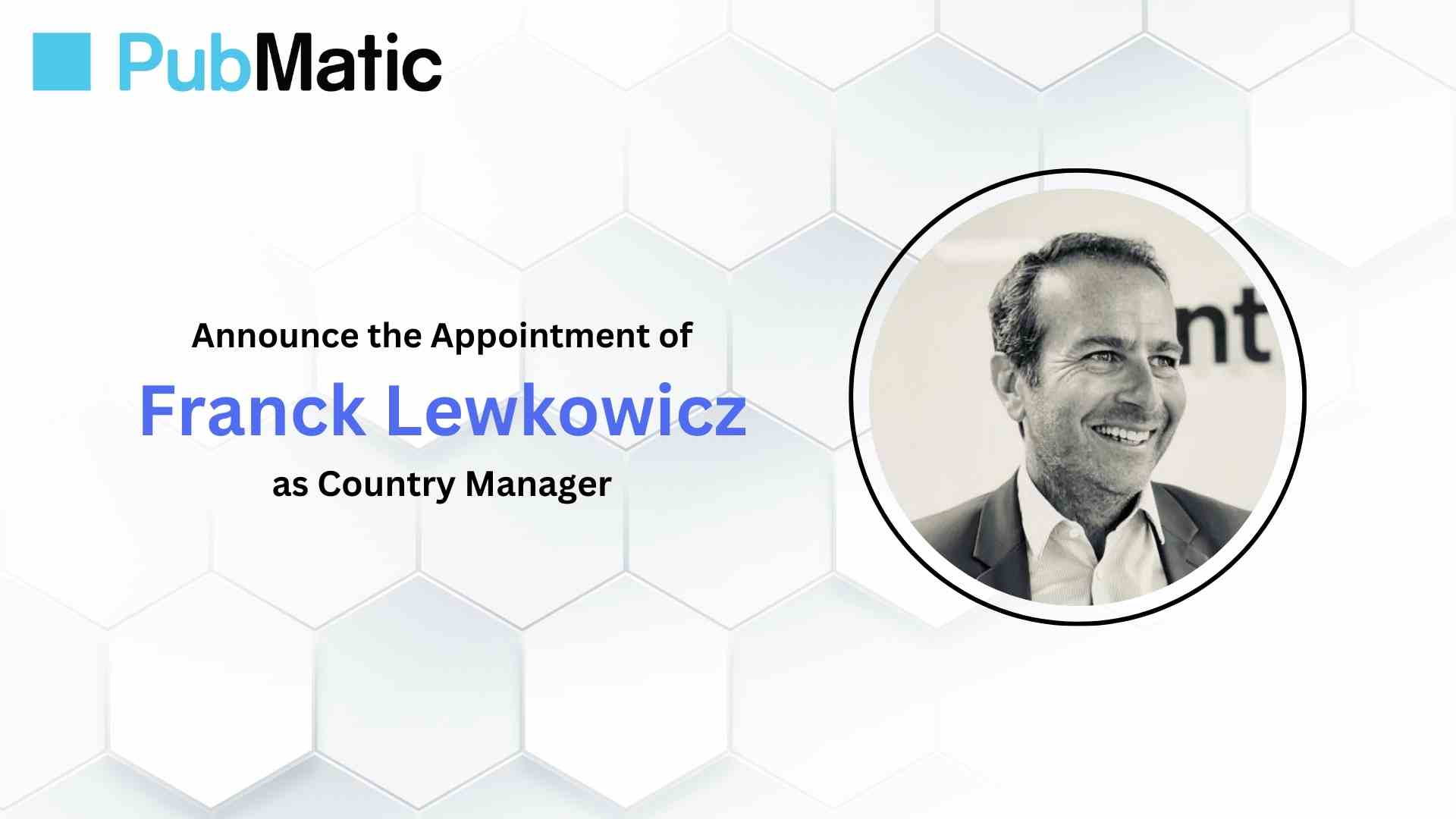
PubMatic Broadens Global Footprint with the appointment of Franck Lewkowicz as Country Manager, France
technology 17 Nov 2023
PubMatic,, an independent technology company delivering digital advertising’s supply chain of the future, is excited to announce the appointment of Franck Lewkowicz as Country Manager, France. In this pivotal role, Franck takes the helm as the primary commercial leader overseeing both seller and buyer teams as PubMatic advances its business in the region.
“We are investing resources to further support publishers and buyers in France and Franck is a leader with deep experience on both sides of the industry to consolidate our position in this market,” said Cristian Coccia RVP Southern Europe at PubMatic. “Franck's expertise in leading strategic initiatives that drive omnichannel performance across multiple platforms and screens makes him an excellent candidate to achieve PubMatic's growth goals in these areas.”
Franck comes to PubMatic with over 20 years’ experience in media and advertising in various leadership roles in sales and client services. Before joining PubMatic, he held various management positions, including Managing Director at Quantcast France, Sales Director at Orange Advertising, and was a distinguished member of the IAB France board (Alliance Digitale).
“Having experienced the evolution of media and advertising throughout my career, I am thrilled to help PubMatic expand our omnichannel offerings to a wider audience of media owners and advertisers,” said Franck Lewkowicz as Country Manager, France at PubMatic. “PubMatic’s best-in-class technology, spanning CTV, online video, display, mobile, and new commerce media offering, combined with our dedicated team of experts in France will help drive programmatic success. PubMatic has long been one of the biggest players in our industry, and following the success of recent launches such as Activate - which puts buyers in control of their media buying strategy, while simultaneously driving more revenue to publishers - I'm very much looking forward to growing the team and delivering the best for our clients.”
Commenting on the appointment, Emma Newman, CRO EMEA said, “Franck’s appointment is a significant milestone in PubMatic’s ongoing expansion in the region. We are delighted to welcome Franck to our EMEA team. His impressive breadth of experience and industry relationships will be vital in accelerating our continuous growth.”
Based in the Paris office, Franck will report directly to PubMatic's RVP of Southern Europe, Cristian Coccia.
Google Cloud and Spotify Expand Partnership to Help Unlock Creator Potential and Reach Fans
analytics 17 Nov 2023
New gen AI tools spur product innovation to improve the world's most popular audio streaming subscription service
Google Cloud and Spotify today announced an expanded strategic partnership to amplify their expertise in infrastructure, data and analytics, and AI/ML technologies. Google Cloud has been Spotify's preferred cloud provider since 2016, and today the platform serves more than 574 million monthly active users. This new chapter will see Spotify exploring using Google Cloud's AI tools to improve critical aspects of the Spotify platform, including:
- Content discovery: Spotify is exploring large language models (LLMs) to better understand the breadth of its content library and augment the metadata used to present this content to users every day.
- Personalized recommendations: Spotify is also looking into ways to enhance the listening experience by using LLMs to understand the patterns behind users' favorite spoken content, such as podcasts and audiobooks, to present new and interesting recommendations.
- Safe listening: Spotify is also exploring the use of LLMs to provide a safer listening experience and identify potentially harmful content.
Spotify has long understood the potential of AI and has been investing in the technology for years, including its homegrown ML Platform on Google Cloud. Machine learning is the foundation for its ability to deliver personalized recommendations through bespoke playlists for listeners.
"We're excited to continue building on the strong and trusted foundation we have established with Google Cloud," said Gustav Söderström - Co-President, CPO & CTO, Spotify. "The evolution of our technology has been matched by Google Cloud's commitment to building the best possible platform for our products to run on and driving further innovation with the emerging capabilities of generative AI."
"Through this expanded partnership, Google Cloud's AI tools are helping Spotify to elevate the listening experience for its customers," said Thomas Kurian, CEO of Google Cloud. "Spotify also recognizes the potential AI can have across their business, and together, we will continue to deliver innovative technologies that benefit their business."
In addition to the potential of AI/LLMs, Spotify and Google Cloud are continuing to deepen their strong engineering to engineering collaboration to scale and grow Spotify's core features and backend platform. Spotify is also continuing to leverage Google Cloud's data capabilities that have driven a wide array of successful campaigns and provide creators with valuable insights and analytics to help them succeed on the platform.
"The collaboration and co-innovation between Spotify and Google Cloud pushes the boundaries of what both platforms can do," said Tyson Singer, Vice President, Technology and Platform, Spotify. "The sheer scale at which we are able to run backend services and process data, in addition to the cost savings we have been able to achieve are crucial to the success of our business."
Beyond being an audio streaming company, Spotify is well known in the developer community as the author of Backstage, an open source framework for building developer portals used by over 2,000 companies worldwide. Backstage removes everyday complexities developers face and Spotify is exploring using Google Cloud's AI capabilities to further simplify actions that slow developers down, allowing them to focus on more important tasks like building great code.

Google Cloud Launches New Vertex AI Search Capabilities for Media and Entertainment Companies
artificial intelligence 17 Nov 2023
Vertex AI Search for media's recommendations capabilities are now generally available, helping to improve audience experiences
Google Cloud today announced new Vertex AI Search capabilities that are purpose-built to help media and entertainment companies give audiences more personalized experiences. Recommendations are our first generally available capabilities, providing media companies with generative AI-powered recommendations that will keep audiences engaged by delivering personalized content recommendations that speak directly to consumers' individual interests.
More than 71% of consumers expect to receive personalized interactions, and 76% get frustrated when that doesn't happen (source: McKinsey). With recommendations, companies can address this frustration, while also benefiting from more meaningful engagement on their platforms. According to a recent Harris Poll study commissioned by Google Cloud, 79% of respondents report having kept a subscription after discovering new content. By providing more personalized content recommendations, media and entertainment companies can increase time spent on their platforms, which can lead to higher revenue and retention.
"Vertex AI Search is becoming an essential tool for media and entertainment companies, helping them improve and deepen audience engagement," said Anil Jain, managing director, Strategic Consumer Industries, Google Cloud. "The new capabilities launched today will provide personalized recommendations for content using gen AI, which can help media companies better engage, grow, and retain their audiences."
Google Cloud is committed to investing in the development of new technologies that are specifically designed to help media and entertainment companies better distribute and monetize their digital content. The new Vertex AI Search capabilities build upon Google's proven track record for developing successful video streaming platforms like YouTube and news aggregator services like Google News, as well as personalized product recommendations for e-commerce.
"Ensuring audience engagement is critical to our business, and gen AI holds the key to delivering personalized experiences that elevate our connection with viewers," says Robin Chacko, EVP Direct to Consumer, STARZ. "With Google Cloud's Vertex AI Search for media and recommendations capabilities, we can deliver tailored content that truly speaks to our viewers' unique interests."
The new recommendations capabilities within Vertex AI Search combine a variety of advanced AI techniques to generate personalized recommendations for content, including:
- Real-time user behavior: Vertex AI Search considers user behavior, such as the articles read and videos viewed, to identify patterns. This translates to recommendations that predict content the user is more likely to engage with. And by working in real-time, the recommendations capabilities can quickly adapt to new viewers and also take into consideration different moods and intentions of a user during any given session.
- Content similarity: Vertex AI Search compares the content of different articles, videos, and other pieces of content to identify similarities, allowing it to generate recommendations for content similar to what the user has already viewed.
Vertex AI Search is fully managed and continually improved by Google Cloud. It can be integrated into consumer touchpoints, including web, TV, mobile, newsletters, and more, using an easy-to-use API. This can allow media and entertainment companies of all kinds to focus their engineering teams on new, differentiated opportunities while still providing cutting-edge personalized recommendations.

2023 QSR Index from Tagger Highlights Influencer Marketing Trends
technology 17 Nov 2023
New Data Provides Insights for QSR Brands to Build and Execute Effective Influencer Campaigns
Tagger by Sprout Social, the global technology leader in making influencer marketing more intelligent, today releases its 2023 QSR Influencer Marketing Index. The report identifies best practices and trends for restaurant brands to refine and optimize their influencer marketing campaigns, including top-performing platforms, content types, and more.
Influencers are an important marketing avenue for quick-service restaurants (QSR) to drive brand awareness and loyalty within their target audience. Social media users are turning to influencers for restaurant recommendations, and brands can tap into these engaged followers through partnerships. As with other industries, there are trending best practices and insights that brands should know to be successful.
Leveraging Tagger’s social intelligence engine, Signals, the QSR Index identifies the following key takeaways for influencer marketing strategies:
- Young Audiences Eating Up Content: Almost two-thirds of the audience for QSRs is under the age of 30; this is a large follower base to reach via strategic campaigns.
- Get it on Video: Other industry reports show that short-form video content is a top performer for QSR brands. Restaurants should ensure Instagram Reels and/or TikTok Videos are included in their campaigns for better engagement.
- Start Small: Influencers with less than 100K followers are seeing the highest engagement rates in the QSR space. Brands should tap into their success.
“Successful social media strategies that include influencer marketing efforts can be a huge advantage for QSR brands as they look to compete in a busy space,” says Dave Dickman, Head of Global Sales and Services, Influencer Marketing at Tagger. “In the 2023 QSR Index, brands can see some of the specific considerations and strategies they need to consider for their current and upcoming influencer partnerships. The data will be useful as we look ahead to 2024 and QSRs set new goals and explore how they can grow.”

Arkose Labs' Report Finds Nearly Three-Quarters of Web Traffic is Malicious, with Generative AI and Cybercrime-as-a-Service Fueling Bot Attacks
artificial intelligence 17 Nov 2023
New Analysis Reveals Increase in Bot and Human-Based Attacks Leading to Darker Effects of Fraud
Arkose Labs, the global leader in bot management and account security, released its threat intelligence report analyzing the contemporary attack landscape. The report, “Breaking (Bad) Bots: Bot Abuse Analysis and other Fraud Benchmarks” found that bots and human fraud farms were responsible for billions of attacks in the first half of 2023 and into Q3. These attacks comprised 73 percent of all website and app traffic measured. In other words, almost three-quarters of traffic to digital properties is malicious.
The report studied billions of sessions worldwide across industries to reveal the top attacks by industry, type, and region. Researchers assessed the attacks across three primary attack vectors: basic bots, intelligent bots, and human fraud farms. Fraudsters use these vectors to launch attack types such as SMS toll fraud, web scraping, card testing, credential stuffing, and more.
The analysis found bot attacks overall increased 167 percent in the first half of the year, weighted heavily by a 291 percent increase in intelligent bots. These smart bots are capable of complex, context-aware interactions. The attacks, though, weren’t limited to bots. Research found that when fraudsters’ bots are blocked, they pivot attacks to human fraud farms, which increased 49 percent from Q1 to Q2 2023.
“Bot attacks aided by human fraud farms are about more than concert tickets and high-priced sneakers. They can point to far darker activities,” said Kevin Gosschalk, founder and CEO of Arkose Labs. “We’re seeing more attacks, using more intelligent bots, conducting more sophisticated types of attacks. Fake account registration, credential stuffing, scraping, SMS toll fraud--these are the types of attacks that fraudsters use as the first steps to more harmful crimes. They lead to romance scams that groom for human trafficking, money laundering from drug deals, or theft to fund illegal weapons.”
Two trends are highlighted in the report as driving the increase in attack level: Generative AI (GenAI), and Cybercrime-as-a-Service (CaaS).
During the past six months, Arkose Labs’ threat researchers have observed a significant uptick of GenAI being used for content generation by bad actors who are now able to write pristine phishing emails for Man-in-the-Middle attacks or perfectly-worded responses on dating apps in their romance scams. In addition, the researchers found attackers are using bots to scrape data from websites and then using that data to tune their GenAI models.
An equally prodigious trend, Cybercrime-as-a-Service (CaaS) lowers the barrier to entry for adversaries looking to commit cybercrime. CaaS vendors advertise their questionably-legal services openly. Anyone can reach out to these vendors to buy bots to circumvent security measures or carry out an attack. Fraudsters with limited to zero technical skills can then use fully automated bots at scale that cause widespread damage to businesses and consumers. Fraudsters no longer have to know how to code to deploy a sophisticated volumetric bot attack. They can simply buy the bots off the web along with the training they need and even tap into the sellers’ “customer” support.
Gosschalk added, “The massive rise of CaaS has completely changed the economics for adversaries. It’s much cheaper to attack companies and the attacks are just better because it’s a dev shop that is doing the attacks instead of just individual cybercriminals.”
Industries Under Attack
With so much traffic to digital properties made up of malicious attacks, Arkose Labs researchers delved more deeply into the specific industries under attack. Nearly every industry experienced an increase in the number of attacks. The report lists the following as the industries that had more than 50 percent of traffic coming from bad bots and details common attacks carried out by malicious bots.
- Travel and Hospitality - 76 percent bad bots
- Technology - 71 percent bad bots
- Retail - 65 percent bad bots
- Streaming - 61 percent bad bots
- Gift Cards - 57 percent bad bots
“Breaking (Bad) Bots: Bot Abuse Analysis and Other Fraud Benchmarks” shares additional insights on how attacks happen and what can be done to detect and block them.

New Report: 89% of Business Leaders Questioning Existing GTM Models, Looking to Change Strategies
customer relationship management 17 Nov 2023
As businesses experience revenue shortfalls, The Future of Revenue report from Crossbeam and Pavilion finds companies moving to more relationship- and ecosystem-based selling strategies
Crossbeam, the Ecosystem-Led Growth platform, today released a new report showing that a majority of sales leaders expect to miss their revenue targets for the year and are rethinking the traditional sales-led growth model. According to The Future of Revenue report, business leaders are struggling to attract new leads, close deals in their current pipeline, and overcome constrained budgets on the buyer side.
To understand the sentiment across different stakeholders in Go-to-Market (GTM) teams, Crossbeam partnered with Pavilion, a private membership organization for GTM leaders, CEOs and their teams, to survey more than 425 business leaders across sales, partnerships, marketing and customer success from August to September 2023. The majority (77%) of respondents work at B2B SaaS companies and 70% are director-level and above.
Of the leaders surveyed, 56% say they don't expect to reach their revenue targets this year, while only 17% report that they expect to exceed annual revenue targets. Compounding the pressure on sales quotas, 54% say the sales cycle has gotten longer over the past two years and only 12% report that it has accelerated.
When asked about the reasons for the revenue shortfall, 46% of sales leaders said it was a lack of high-quality leads, and 43% pointed to a lack of alignment with the marketing team. As a result of these challenges, 89% of all respondents say their companies are looking to change their sales strategy and looking for alternatives to the traditional top-down sales approach.
Embracing Change, Bringing Trust Back to Sales
More than two-thirds (68%) of GTM leaders said that buyers have more control over the sales process, acknowledging that buyers are focusing more on insights and opinions from sources within their own trusted ecosystem.
As GTM leaders embrace change to increase revenue, they are leaning more on relationships and social selling within a broader ecosystem. This ecosystem consists primarily of customer referrals (42%), strategic partners (32%), internal stakeholders at their companies (28%), personal networks (22%) in addition to other connections.
There have been many SaaS growth strategies that have gained momentum over the past few years, including Product-Led Growth and Sales-Led Growth. When asked about the sales strategy they have been focusing more on over the past year, the top choice among 48% of sales leaders was an emerging growth strategy: Ecosystem-Led Growth (ELG) and co-selling with partners. Ecosystem-Led Growth is a go-to-market motion that focuses on partner ecosystems as the primary way to attract, convert, and grow customer relationships.
The shift extends beyond sales teams; marketing leaders are leaning into channels they have more control over. The two largest ways marketing strategies have changed over the past year are through collaboration with partners to generate and nurture leads through co-marketing, and email marketing, which continues to be a mainstream communication channel.
"Today's challenging selling environment has created a market shift away from traditional go-to-market playbooks to alternative strategies," said Bob Moore, chief executive officer and co-founder of Crossbeam. "But change doesn't always require an overhaul of the current system — an existing resource can rewrite old playbooks. That's the beauty of Ecosystem-Led Growth. There are substantial and relevant business opportunities for leaders in their own ecosystem that impact every stage of their revenue funnels."
"Visibility into new connections and overlaps in a partner ecosystem surfaces the people and companies in their network that will accelerate and close higher-quality deals," continued Moore. "The over 17,000 companies on the Crossbeam network are seeing high engagement and strong results, out-executing their competition at a blistering pace. The customer relationships generated via ELG have higher contract values, close faster, see higher win rates, and expand more meaningfully over time."
In the report, sales leaders said after implementing ELG, 81% saw deals close faster than before and 89% said ELG deals are more likely to close.
"More than 10,000 members on Pavilion are reevaluating deteriorating and expensive outbound motions that are no longer working," said Pavilion chief executive officer Sam Jacobs. "We're seeing that they are increasingly interested in new sales strategies, and are investing into partnerships and ELG as a more efficient — and more human — way to go-to-market."
'Do It Right' with AI: Ally creators experiment with generative AI in marketing test case
artificial intelligence 17 Nov 2023
Early results show Ally.ai capabilities could boost speed, drive team creativity and productivity
Ally Financial Inc. announced today the early results of an experimental generative AI use case with its marketing team designed to help understand the real-world impact the technology could have on campaign development and employee productivity. Using the Ally.ai platform's large language model (LLM) chat and prompt functionality, a select group of marketers were able to reduce the time needed to produce creative campaigns and content by up to 2-3 weeks and reported an average time savings of 34%, compared to typical processes without AI.
Additional results reported from the month-long experimental program include:
- The reduction in time needed for content creation and other marketing outputs of up to 2-3 weeks was primarily found in the early stages of the creative process in tasks such as research, first drafts and naming exercises
- The 34% time savings on tasks when using the Ally.ai interface could equate to an annual savings of almost 3,000 hours across the participant team
- More than 80 prompts developed by participants during the test had an 87% usefulness rate, showing the value of prompt engineering training for teammates and the effectiveness of outputs that could be used in assigned work
- Users also noted a prompt accuracy rate of 81%, signifying that they received the right type of content or response outputs from the Ally.ai platform to complete their assignments
- Participants also saw usefulness and accuracy in outputs when using Ally.ai for data analysis, quality controls and search engine optimization (SEO)
"The best marketing teams know the art of evolution, which includes evaluating and testing of transformative technologies," said Andrea Brimmer, Chief Marketing and Public Relations Officer at Ally. "The early results demonstrate how AI could enable our talent to focus on creative tasks that needed the most human involvement, while speeding up the routine efforts of our day-to-day work. We look forward to the continued exploration of generative AI and learning more about how the technology can assist our team."
Ally.ai, the company's proprietary, cloud-based AI platform that serves as a secure, private bridge between enterprise-grade LLMs and Ally's data and AI applications, launched in June 2023. The test with marketing comes on the heels of Ally's pilot with its Customer Care and Experience group where Ally.ai was used to quickly and accurately summarize customer service calls, helping associates focus their energy on more meaningful customer interactions and reduce the time needed to service and close a customer inquiry.
Both use cases reflect a commitment to Ally's core principles for the enterprise use of AI: initially focusing on use cases that support employee productivity and optimizing internal business processes; providing human intervention and controls for oversight and training; protecting against the disclosure of personal identifying information and prohibiting third party model providers from using Ally data to train their foundational models.
"The purpose of building Ally.ai in-house, and with foundational data, cloud and network infrastructure already in place, is to scale its use throughout the organization while also keeping a close eye on potential risks and opportunities for new use cases," said Sathish Muthukrishnan, Chief Information, Data and Digital Officer at Ally. "The value that our marketing colleagues could get from Ally.ai demonstrates how important cross-functional collaboration is to the development of enterprise AI capabilities."
Generative AI in Marketing: Supporting Productivity
In addition to the preset system prompts and security features already embedded in Ally.ai, the platform needed a place where teammates could engage with the LLM directly. Understanding that most LLMs and generative AI applications are good for summarization, content creation, ideation/brainstorming, and information analysis, Ally's developers built an open prompt user interface (UI) for Ally.ai that would allow teammates to do two types of work: chat directly with the secured LLM and also develop specialized prompts that could be saved, used again, and shared with colleagues based on their accuracy and usefulness rates.
Teammates could change features of the platform depending on the work they did, including toggling between chat and prompt mode, adjusting prompt length as well as the model's creative parameters and vocabulary. The participant team frequently used Ally.ai as a starting point for creative development, specifically for first drafts of advertising copy, video scripts or social media posts, or enhancing human-driven ideas that originated from brainstorms or naming exercises.
An example: the content team performed a test of Ally.ai by providing the platform with a transcript of a podcast that featured an Ally executive. The team asked the platform to create the first draft of a 750-word article for Ally's Conversationally blog with the information provided, plus direction to incorporate the most insightful, informative and entertaining parts that would be relevant to consumers. While the Ally.ai output required editing and the finesse of Ally's content writers and it still went through Ally's well-established regulatory review processes, having a quick first draft done in 15 minutes helped reduce the total time needed to create and edit the blog article from four hours to just one.
"We look at Ally.ai as an assistant that will be able to help our teammates with faster and smarter project delivery, which leads to a better experience for our customers," Brimmer said. "In several different instances, our content writers were able to use thoughtfully crafted prompts to either start up the creative process or help extend the distribution of content to new channels. Anytime we can reduce the time to publish while also letting our creatives do what they do best, that means a lot in our fast-moving, competitive environment."
With the Ally.ai UI in place, Ally teammates can be trained to use it for the exploration and development of approved business use cases. The opportunity to learn more about AI and train using the platform has created a positive energy inside the company. Earlier this month, Ally hosted its second AI Day – a half-day dedicated to education and knowledge sharing around AI – with almost 1,000 teammates from multiple business units in attendance.
"You can't escape the conversation around AI, so we are taking hold of that momentum and using it as a springboard to continue to explore new use cases that will drive AI adoption internally while supporting business goals," Muthukrishnan said. "Right now, there are more than 100 use cases being carefully evaluated throughout the enterprise. While not all of them will pass our rigorous testing, we remain optimistic about what AI can bring to our teammates at Ally and to the financial services industry."

OpenX Announces TV+, the Programmatic Industry’s First Initiative to Unlock the Full Potential of Biddable CTV
advertising 17 Nov 2023
OpenX will improve trust and transparency in the CTV market by removing all resellers and eliminating all non-TV content from its CTV inventory.
OpenX Technologies, Inc., one of the world’s leading omnichannel supply-side platforms, today announced the launch of TV+, an ongoing initiative to unlock the full potential of CTV by combining the most powerful aspects of linear and programmatic buying models.
In the current CTV landscape, buyers aren’t able to efficiently buy in biddable media environments due to an over-indexing of intermediaries. Additionally, brands and agencies often pay CTV CPMs without having full transparency into what they’re buying. When non-TV content is categorized as CTV, publishers’ premium content is devalued and buyers cannot lean into their KPIs with confidence.
In this first phase of TV+, effective today, OpenX will eliminate all resellers from its CTV inventory pool, ensuring that buyers have more working media and reduced invalid traffic. This move also ensures that publishers get their fair cut of transactions to power the development of high-quality content for consumers.
Additionally, OpenX will today remove all non-TV content, including fireplace apps, gaming, UGC, OTT, and mobile, from its CTV inventory. While OpenX will continue to monetize these types of inventory as online video rather than CTV, this phase of TV+ properly classifies content, providing more premium advertising experiences, a clear value for inventory, and more accurate measurement.
This first step in the TV+ mission to transform programmatic CTV into a high-quality marketing opportunity allows publishers to confidently place their premium inventory into biddable environments while giving brands and agencies full transparency into what they’re buying. With these innovations, TV+ delivers a fair and transparent value exchange between publishers, agencies, and DSPs.
“CTV is a powerful channel for marketers to reach and engage with their audiences,” said Adam Roodman, SVP of product strategy and management at Yahoo. “As this happens, solutions that prioritize control and transparency will enable buyers to lean into their KPIs in biddable CTV environments, helping them further realize the full promise of programmatic CTV.”
“As more marketers choose CTV for incremental reach over linear, there's tremendous value for the ecosystem in scaling reach beyond direct buys," said Ashwin Navin, co-founder and CEO at Samba TV. “Solutions that provide trust and transparency empower data providers to scale audiences in CTV and digital while increasing confidence in biddable environments and optimizing working media.”
Through TV+, buyers unlock direct premium publisher integrations across more than 110 million measurable “glass-on-wall” devices. This access to direct-sourced inventory improves transparency and control, while log-level data delivers visibility into impressions.
Further, this initial phase of TV+ protects consumers’ interests by ensuring they're getting the premium content they signed up for because premium publishers are able to secure an appropriate price for their inventory and invest resources back into creating premium content.
"The long-term growth of biddable TV advertising requires buyers and sellers to have confidence in marketplace integrity," said Chris Kane, founder of Jounce Media. "OpenX’s TV+ creates these conditions, ensuring media buyers get the quality they expect from their TV investments and ensuring media owners, not supply chain intermediaries, are the beneficiary of those investments."
“I've spent the majority of my career in TV, and ensuring that CTV doesn't repeat the same cycles as digital is imperative to the success of programmatic TV,” said Geoff Wolinetz, SVP of publisher and demand platforms at OpenX. ”As we embark on creating the future of CTV, we have the opportunity to make programmatic TV more efficient and effective by ensuring content is fit for purpose, accessed directly, and demand and supply partners have transparency across the value chain. This will positively impact buyer confidence, enabling them to implement key strategies such as incremental reach.”
Page 961 of 1509