News
Almost 60% of organizations are implementing or exploring generative AI in marketing
artificial intelligence 12 Dec 2023
Almost 60% of organizations are implementing or exploring generative AI in marketing
And three quarters of organizations have either already allocated budget to integrate generative AI into marketing, or plan to do so in the next six months
Paris, December 11, 2023 – The majority of marketers (62%) believe that generative AI will augment human creativity, enhancing unique human qualities such as intuition, emotion, and context understanding. Organizations already investing in generative AI for marketing dedicate 62% of their total marketing technology budget towards it, seeing this breakthrough technology as a catalyst for creativity and innovation in marketing. That’s according to Capgemini Research Institute’s latest report ‘Generative AI and the evolving role of marketing: A CMO's Playbook’, which reveals that half of organizations have already set aside specific budgets and almost half (47%) have allocated teams for the implementation of generative AI in marketing.
The report found that 57% of marketers expect generative AI to act as a catalyst for unlocking new creative possibilities, particularly when collaborating between human and AI-driven innovation; 55% foresee this motivating teams to think beyond conventional boundaries. In the next two to three years, marketers already using generative AI expect it will be applied across data analysis (90%), search engine optimization (89%), customer services (89%), content creation (88%) and image and video generation (86%). As a result, marketing functions are actively establishing practices to use generative AI across marketing domains.
According to the research, organizations believe that this technology can help in building a unique brand image (67%), accurate analysis of customer and market trends (65%), reduction in marketing costs (66%), and increase efficiency in generating content and results (65%).
Gagandeep Gadri, Managing Director of frog, part of Capgemini Invent, said, “The future of marketing will undeniably be influenced by the widespread adoption of generative AI to deliver personalized content and communication; it’s value realization will need a fusion of strategic choices, human centered creativity and a good understanding of the art of the possible in a very fast-moving space. In many ways this feels like the Digital boom from 20 years ago, where the brands that succeeded were those that stayed true to their values but were brave and bold on how digital could deliver growth for their business. The same will apply for generative AI.”
Addressing ethical and regulatory issues will be key
As AI algorithms become increasingly sophisticated, marketers will continue to face complex ethical considerations around issues such as the responsible use of customer data, the transparency of AI-driven decision-making processes, and ensuring algorithms do not reinforce social inequalities.
The research indicates that only 30% of organizations have implemented clear guidelines for the use and oversight of AI systems and less than half consider attributes of trust, privacy, and responsibility when selecting AI systems for marketing activities. Less than half of organizations (42%) are implementing measures to protect themselves from challenges related to the use of generative AI in marketing, such as monitoring or searching for AI-derived versions of their work, including logos and artwork.
Bridging the generative AI skills gap
According to the report, the majority of organizations (71%) anticipate that certain marketing roles will be significantly or moderately impacted by generative AI including SEO specialists, digital marketing and creative directors, PR/communication specialists, copywriters, and customer insight specialists.
The majority (63%) of organizations recognize that the demand for generative AI skills in marketing significantly outstrips supply. To address this skills gap and harness the full potential of generative AI in marketing, organizations are implementing internal and external strategies. On average, 53% of companies are planning to provide generative AI training for their marketing teams in the next six months, with companies in the Netherlands, India, Australia, and the US most likely to implement this initiative. Sectors such as media, insurance, automotive, and life sciences also show higher-than-average commitment to generative AI training for their marketing teams.
Marketing is emerging as a strategic force to drive organizational success
The research shows that marketing has transformed in recent years, with Chief Marketing Officers (CMOs) increasingly playing a central role in strategic decision-making processes. In business-to-consumer (B2C) sectors, 71% of C-suite respondents see marketing as a strategic partner in driving business growth and 72% of B2C organizations involve the CMO in critical decisions to drive business goals and objectives. CMOs have assumed greater direct responsibility for contribution to revenue growth (49%) and profit-related decisions (44%) over the past two years, increasing by 25 and 19 percentage points from 2021 respectively.
Almost 60% of organizations are integrating generative AI into their marketing efforts, out of which 37% are actively implementing it across various initiatives, while an additional 21% are in the experimental phase. In order to succeed, organizations are adopting diverse AI strategies tailored to their specific marketing needs and available resources. Nearly a quarter of organizations rely solely on external applications and platforms for generative AI in marketing, however, half of them are in the process of either developing or using in-house applications alongside external tools.
Methodology
The Capgemini Research Institute surveyed 1,800 executives overseeing marketing strategies across diverse organizations worldwide with an annual revenue of over USD 1 billion. The organizations came from a range of sectors, including automotive, banking, consumer goods, insurance, retail, telecom, utilities, high-tech, manufacturing, life sciences, public sector and media. They are based in 14 countries across North America, Europe, and APAC. In addition, 25 in-depth interviews were conducted with Chief Marketing Officers and marketing leaders with firsthand knowledge or awareness of their organizations generative AI initiatives. Charts comparing 2021 and 2023 data exclude respondents from B2B sectors, as they were not part of the 2021 survey. The covered sectors include automotive, banking, consumer goods, insurance, retail, telecom, and utilities.

Marketing Interns Won't Be Replaced by AI, But Are Instead in Higher Demand in 2024
artificial intelligence 12 Dec 2023
71% of SMBs would pay more for marketing interns with AI skills, according to GetApp's new survey
As AI takes over a vast range of professional work, a key question is whether marketing internships will become obsolete. New findings from GetApp’s 2023 AI Impact Survey of 400 small and midsize businesses (SMBs) reveal the contrary. More than one-third (36%) of SMBs say that AI will actually increase the demand for marketing interns in 2024.
This demand for interns is fueled by the growing use of AI technology by SMBs. Over half (52%) of SMBs leverage AI for marketing-related tasks or functions. It’s no surprise then that 42% of businesses are looking for AI experience or skills when hiring a new intern. Furthermore, 71% would pay more for marketing interns with AI skills or experience.
SMBs rate data analysis as a highly useful application of AI as it can easily help accelerate aspects of data processing and interpretation. To that end, these businesses say they would most like their interns to leverage AI for these marketing-related tasks: analyzing data (48%), reducing mistakes (42%), and increasing the speed or efficiency of workflows or processes (36%).
The educational aspect of internships gives way to an often mutually beneficial relationship: Interns get real-world experience and mentorship, while companies get to leverage diverse skills and tap into potential new talent. Developing talent is a top driver (41%) for SMBs to leverage internships, along with encouraging mentorship (42%) and increasing productivity (40%).
Amidst the allure of AI’s potential, SMBs must strive to balance technology integration and human capability. More than half (56%) of SMBs believe that less than 25% of marketing-related responsibilities performed by interns can realistically be performed by AI, indicating that human involvement remains essential. Additionally, 76% respondents prefer offloading work to a human versus software.
Furthermore, 51% of SMBs believe that AI may hinder the experiences of marketing interns in their roles. These businesses are mostly concerned about AI’s role in reducing problem-solving skills, hands-on learning, and creative expression. One way to avoid these potential pitfalls is to leverage project-based learning that provides opportunities for knowledge building.
“Despite AI’s disruptive impact on the job market, it won’t replace marketing interns at SMBs,” says Meghan Bazaman, senior marketing analyst at GetApp. ”Rather, AI can serve as a valuable resource for interns to elevate their capabilities without eliminating hands-on learning experience. This ultimately helps SMBs cultivate a strong pipeline of marketing talent and promote a growth-oriented environment.”

RingCentral Announces Return of Vlad Shmunis as CEO
artificial intelligence 12 Dec 2023
Reiterates Fourth Quarter and Full Year 2023 Guidance
RingCentral, Inc., a leading provider of AI-first global enterprise cloud communications, video, webinars, hybrid events, and contact center solutions, today announced that Tarek Robbiati and RingCentral mutually agreed that Robbiati would separate from the company and resign from the Board of Directors, effective December 8, 2023. Robbiati’s resignation is not a result of any disagreement with the Company or the Board, or any matter relating to the Company’s operations, policies, or practices. Vlad Shmunis, RingCentral’s founder and Executive Chairman of the Board, has returned to his full-time role as Chief Executive Officer. Shmunis will remain Chairman of the Board.
Rob Theis, Lead Independent Director of RingCentral, said, “RingCentral’s strategic product vision and operations are closely linked, and we determined it is best to have one leader with oversight for all aspects of the organization. As RingCentral’s founder and long-term CEO, Vlad has overseen the Company’s growth from inception to a leading SaaS provider with over $2.2 billion in revenue. We are confident that he will be effective in his return as CEO and will continue delivering for all our stakeholders. We appreciate Tarek’s contributions and wish him well.”
“We are at a tremendous inflection point in our industry and it is critical that our product and innovation strategy drives all that we do and is closely aligned with how we go to market,” Shmunis said. “We have a world-class team, battle-proven technology, and a clear roadmap with a large and untapped market opportunity ahead of us. I am fully committed to RingCentral and am confident in our ability to drive sustainable, profitable growth moving forward that is rooted in our core values of trust, innovation, and partnerships.”
Robbiati said, “I have the utmost respect for the RingCentral team. I wish the company and its people the very best. RingCentral has tremendous products and I believe the Company will continue to deliver for its customers and shareholders.”
Reiterates Fourth Quarter and Full Year 2023 Guidance
RingCentral reiterated its previously issued fourth quarter and full year 2023 guidance range on revenue, non-GAAP operating margin and adjusted, unlevered free cash flow, as previously issued on November 6, 2023.

Cloudinary Report: Brands with Optimized Online Visual Content See Boost in Customer Engagement, Resource Savings and Sustainability Gains
technology 12 Dec 2023
AI saving brands an average of 34 working days per month; most countries now officially mobile-first; and well-optimized images and video help brands greatly reduce their carbon footprints
Cloudinary today launched its fifth annual State of Visual Media Report, offering an in-depth look into how the world's most engaging brands are harnessing the power of visual content to deliver more compelling and profitable digital experiences, at scale. Representing an analysis of 8.5 trillion visual asset transactions across 439 global brands, the Cloudinary report offers insights into the major role AI continues to play in image and video optimization, the visual experience “must haves” when it comes to Gen Z consumers, and the near global dominance of mobile-first experiences. The report also reveals how properly optimized visual content is helping brands greatly reduce their digital carbon footprints.
Generative AI continues to take hold. This year’s report reveals that brands were exceptionally fast to adopt new AI capabilities. AI is not only helping to bridge the labor shortage of web developers, but it’s also freeing tech teams to do more strategic work and be more productive. After analyzing just one month of data across 180,000 users, Cloudinary determined that AI automation features saved customers an average of 34 working days.
Mobile is King. Three industries dominate reaching customers via mobile devices over desktops: retail and consumer goods (75.3%), food and beverage (73.1%), and financial services (63.5%). While mobile has emerged as the preferred way to browse the web in most countries, there are still major geographical differences. 76% of media requests in Mexico originate from mobile, and just 41% in Japan. In terms of demographics, and according to a recent Cloudinary e-commerce survey, Gen Z (73%) consumers primarily shop online using their smartphones, and these digital natives aged 11-26 are also the most likely group to use a brand's app to shop (26%).
Website carbon footprint a key consideration. As consumers raise expectations for their favorite brands to operate more sustainably in the face of the climate crisis, CIOs and CMOs are finding ways to optimize their online images and videos as part of the solution. A company’s website can contribute to a large carbon footprint with bandwidth-hungry images and videos, as serving and storing them demands servers that need power to run and be cooled. Visual media optimization is showing to be a clever solution. If we look at just one month of the sample data in this year’s report, CO2 savings, thanks to optimization, were impressive: each customer saved an average of 5,342kg of CO2, roughly the same as 5 long-haul flights.
Images and video are the story
“Since our inaugural report, the world has seen unprecedented global events and seismic shifts in demographics and social attitudes transforming consumer expectations and market behavior,” said Genevieve Haldeman, vice president, corporate marketing, Cloudinary. “This year’s report offers an in-depth look into the ways in which brands are managing and delivering image and video content to meet these challenges. From retail to publishing, travel to entertainment, one consistent thread remains. When it comes to successfully engaging today’s consumer, images and video no longer play leading roles in the story. They are the story. What was once considered a leg up is now table stakes and something brands must get right.”
Methodology
For its 2023 report, Cloudinary analyzed the visual content engagement patterns from August 2022 through August 2023 across 439 Cloudinary customers, a dozen vertical industries and over 8.5 trillion transactions.
Data Capture and Workflow Automation Leader Formstack Acquires Formsite
data management 12 Dec 2023
Workflow automation provider expands leadership position in the data capture and forms market; extends capabilities for Formsite customers
Formstack, a PSG and Silversmith-backed software-as-a-service (SaaS) company that provides a versatile, no-code suite to create and orchestrate workflow with custom forms, documents, and eSignatures, today announced the acquisition of Chicago-based forms provider, Formsite. This acquisition aligns with Formstack's mission to empower users with practical solutions to everyday work problems and bolsters its position as a leader in the data capture and forms market.
Over the past few years, Formstack has expanded its data capture capabilities to include document creation and management, electronic signature capture, and visual workflow building, enabling users to tap into powerful, end-to-end workflow automation. The combined capability is delivered as part of a powerful suite of tools that allows users to put their data to work for them in any number of ways and deliver relevant information to key systems via countless integrations with third party tools. Over 20,000 organizations, including Advent Health, Virgin Galactic, and Netflix rely on the Formstack suite of products to collect and manage data.
With this acquisition, existing Formsite customers will gain access to Formstack’s differentiated capabilities and advanced workflow automation. It will also enable Formstack to reach a wider audience and offer a broader range of solutions, ultimately strengthening its position in the market and improving its ability to meet the evolving needs of businesses and organizations.
“Formstack has a history of helping customers capture data and put it to work,” said Rob Lawrence, Chief Operating Officer of Formstack. “This acquisition strengthens our position as a leader in the data collection market and will also enable Formsite users to tap into all of our additional offerings and derive even more value from their current deployments of Formsite. We are excited to welcome these new customers and the Formsite team to the Formstack community, and introduce them to our world class service and product offerings.”
Founded in 1998, Formsite was started by Randy Vroman as a way to help a colleague create their own Internet survey without assistance from others. Over 25 years, Formsite’s data capture capability has evolved to allow customers to build online forms and surveys without the need for programming knowledge. With over 10,000 customers, Formsite has grown organically without any external investors, stockholders, or pressure to compromise their mission to provide a world-class online forms and surveys platform.
“We’re incredibly excited about the value this acquisition will deliver to Formsite customers,” said Randy Vroman, CEO of Formsite. “Formstack has built an incredible suite of workflow automation tools that will allow our customers to put their data to work in new and interesting ways. Our customers can expect the same great product experience and responsive customer service they have come to expect from Formsite and will experience complete continuity with no disruption to their current data capture solutions.”
Over the next few months, the teams will be working on deeper integrations between the two offerings and the Formsite team will be stepping into new roles at Formstack.
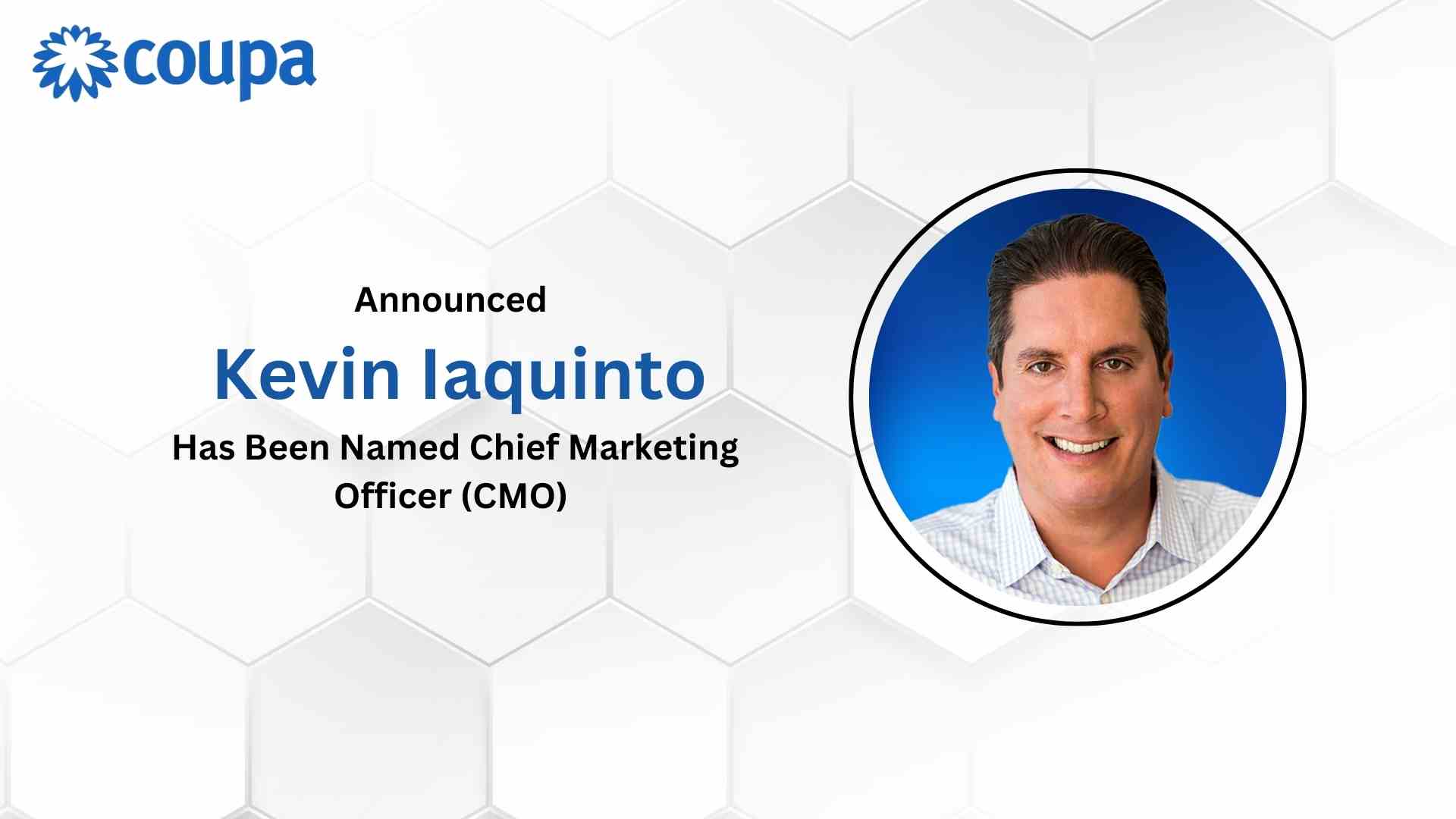
Coupa Welcomes Kevin Iaquinto as Chief Marketing Officer
business 12 Dec 2023
Iaquinto brings a proven track record of successfully supporting durable growth at scale
Coupa, the leader in Business Spend Management (BSM), today announced Kevin Iaquinto has been named Chief Marketing Officer (CMO). Kevin brings more than 25 years of proven, at-scale, technology marketing leadership experience to Coupa. During this ever-changing macro environment, customers need the value and insight derived from partnering with Coupa more than ever.
"Kevin is a passionate, committed, and proven leader who has run award-winning marketing teams and guided companies through significant scaled-growth phases, acquisitions, and IPOs. With so many opportunities for at-scale CMOs in the market, I am delighted that Kevin has chosen to join us at Coupa," said Leagh Turner, Coupa CEO.
"I love Coupa's mission to make every dollar matter. Coupa is on a path to becoming a generational company, which also means becoming a generational brand. I'm looking forward to helping us achieve that. We're going to find new and innovative ways to connect with our customers and community. We're going to scale and amplify our activities and team to reach new levels of success. And we're going to sharpen our go-to-market story in a way that accelerates demand and delivers sustainable, durable growth for the business," said Iaquinto.
Iaquinto brings more than two decades of technology marketing experience to Coupa and was most recently CMO of CommerceHub. Prior to that, he was CMO of Blue Yonder, where he helped lead a brand and business transformation that resulted in Panasonic's acquisition of Blue Yonder in 2021.
Iaquinto has also held CMO roles at software leaders Deltek and Software AG. He has been named Marketing Executive of the Year by PR World News, and he and his teams have won numerous other industry awards and honors.

Similarweb and HypeAuditor Release Digital Marketing Benchmarks for Seven Industries
digital experience 12 Dec 2023
Benchmarks report offers free access to wealth of competitive intelligence
In a time of economic and budgetary turmoil, digital marketers can take advantage of a free resource to understand the competitive landscape and how they can compete better.
“This is the kind of comparative data companies often spend a lot of money having consultants compile as they seek to optimize and improve their own performance,” Similarweb CEO Or Offer said. “We’re sharing it for free to give businesses who operate online a taste of what our platform offers in terms of competitive intelligence. And of course, we stand ready to assist clients with deeper and richer investigations of the online landscape across the web, mobile apps, and ecommerce platforms.”
The 2024 Marketing Benchmark Report, created in partnership with influencer marketing specialist HypeAuditor, presents detailed digital marketing benchmarks for seven industries in the US: Hotels & Accommodation, Beauty & Cosmetics, Consumer Electronics, Home and Garden, Jewelry & Luxury, Pet Food & Supplies, and Fashion & Apparel.
"It’s safe to say that influencer marketing has come a long way since its inception; no longer on the sidelines of the digital marketing landscape, it now stands as one of its pivotal forces,” HypeAuditor CEO Alex Frolov said. “This report underscores the most essential influencer marketing metrics, and in doing so, makes a startling revelation – not only has influencer marketing become integral to shaping brand narratives and connecting with audiences, but it has also reached a point where its impact is nearly equivalent to that of other marketing channels."
For each of the seven categories, Similarweb and Hype Auditor studied 1,000 of the most visited web domains to determine what separates the “giants” (the top 10) from the challengers (ranked 11 to 100), and the “up-and-comers” (101-1,000).
Key metrics covered include:
- Website traffic: overall and by specific marketing channel (including direct, organic, paid, and referral)
- Website engagement metrics: bounce rate, pages per visit, time spent on site
- Instagram followers
- Influencer marketing reach
With Google algorithm changes, AI disruptions, and the growing importance of TikTok and Instagram influencers, keeping track of the competitive environment is more important than ever. Getting ahead requires knowing where your organization leads and where it is lagging.
Unfortunately, benchmarking is a complex task that’s often forgotten, deferred, or squeezed out of budgets. “With this report, we can help digital marketers contextualize their performance, set goals and find opportunities in 2024,” Offer said.
84% of B2B Deals Are Decided Before Marketers Even Know About Them
marketing 12 Dec 2023
6sense Study Shows Marketing is a Key Differentiator in the Pre-Decision Gap, AI Solutions Can Help Reach Buyers Sooner in the Purchasing Journey to Drive B2B Revenue Production
B2B selling teams are at a disadvantage, according to the 2023 B2B Buyer Experience Report released from 6sense today. The report indicates that marketing efforts play a critical role in the B2B buying journey with 84% of deals decided upon first contact – made by buyers. These insights come at a time when sales and marketing executives agree that revenue generation has become increasingly difficult.
While B2B sales and marketing teams now have access to more insights and data than ever to enable smarter sales strategies, the study also emphasized that buyers initiate contact with sellers directly – when they are already 70% through the buying process – which translates to eight months in an average deal cycle.
The research makes it clear that B2B organizations should exert considerable marketing effort to create awareness and develop a relationship with members of the buying committee early in the buying process to create a competitive advantage. In doing so, buyers are influenced towards their solutions sooner, simplifying the buying process and contributing to a better long-term customer experience.
Solutions utilizing artificial intelligence (AI) will be key in bridging the gap between B2B buyers and revenue teams to enable stronger strategy alignment. With technology solutions powered by AI, companies can more accurately pinpoint best-fit opportunities while they are early in their buying journeys. This allows B2B sellers to fully focus on enabling buyers to choose them outside of the selling process through opportunities like industry events or via online communities.
“AI has been a great enabler for sales and marketing teams. We’re in an age where immense amounts of data is at our fingertips,” said Kerry Cunningham, Head of Research & Thought Leadership at 6sense, former Forrester Analyst. “Armed with that data, go-to-market organizations can cover prospects in the pre-decision phase of their journeys and direct their very best efforts where those efforts are likely to produce the best result.”
Underpinning the need for effective sales and marketing solutions, the survey found:
- Buyers engage with sellers when they are ready — not before — about 70% through their buying journeys
- By the time of this first contact, 78% of buyers have mostly or completely established their business requirements
- Thus, 84% of buyers said the first vendor they contacted ultimately won the business
- This means, if vendors haven’t won buyers over during the first two-thirds of the buying process, based on the results of this study, they have a mere 16% chance of winning a deal
- By influencing buyers early in their journeys through effective marketing strategies, selling organizations can eliminate competitors and shorten buying cycles substantially
The study was conducted between June and July 2023 which evaluated feedback from more than 900 B2B buyers with respondents representing the technology, accounting, legal, and purchasing departments. Each participant had engaged in a B2B purchase of greater than $10,000 in annual value within the last 24 months.
Page 911 of 1491