
artificial intelligence marketing
Monks Taps Thiago Correa to Lead AI-First Media Strategy Across EMEA
Monks Taps Thiago Correa to Lead AI-First Media Strategy Across EMEA
 PR Newswire
Published on : Dec 9, 2025
Monks is doubling down on a simple but increasingly unavoidable reality of modern marketing: media is no longer bought—it’s computed.
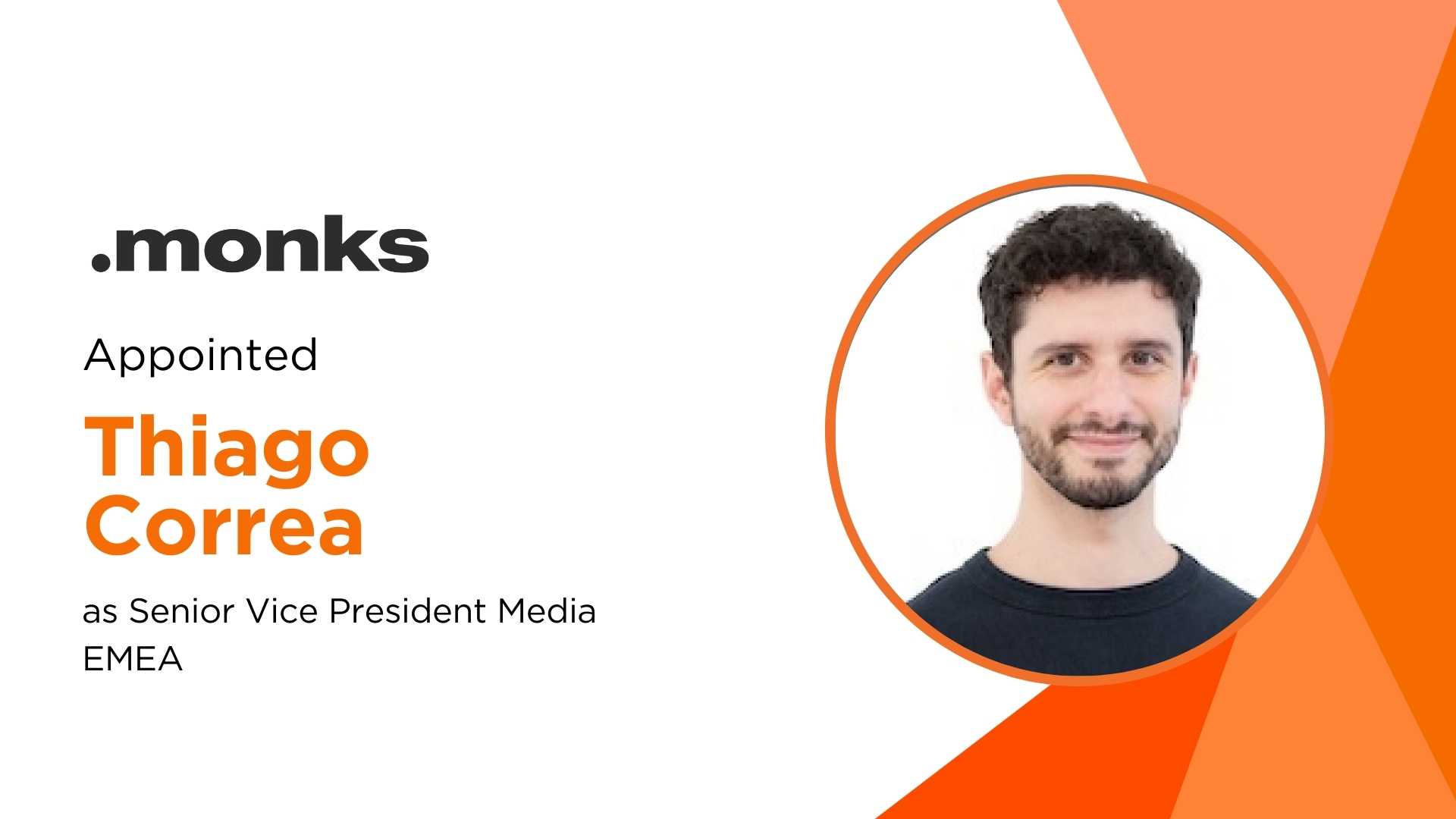
The S4 Capital–owned, digital-first services company has appointed Thiago Correa as Senior Vice President of Media for EMEA, tasking him with helping brands recalibrate their media strategies for an era defined by algorithms, automation, and AI-led decisioning. It’s a hire that reflects a broader shift underway in the media industry, where the biggest ad platforms are also the most advanced AI companies—and where traditional agency models are starting to show their age.
Correa will report to Linda Cronin, EVP of Media at Monks, and joins at a moment when brands are grappling with fragmented journeys, opaque measurement, and platforms that increasingly operate as black boxes. His remit: future-proof client media strategies by leaning into the same forces reshaping the platforms themselves.
When Media Channels Become AI Companies
One of the more pointed observations behind Correa’s appointment is that the leaders of the AI revolution—Google, Meta, Amazon—are also the world’s dominant media ecosystems. These platforms no longer reward manual optimization or siloed planning. They reward clean data, high-quality signals, and creative scale.
Monks has built close partnerships with these platforms, positioning itself as an automation-first media partner rather than a traditional programmatic buyer. Correa is expected to help clients navigate what Google famously calls the “messy middle”: the unpredictable, non-linear path between discovery and conversion that algorithms now mediate.
In practice, this means shifting away from channel-by-channel decision-making toward systems that integrate creative, data, and measurement into a single operating model—something Correa argues is no longer optional.
“AI rewrites the economics of media, stripping out the manual middle where most of the margin sat,” Correa says. “The winners will be integrated, automation-first partners that connect creative, data, and measurement into one system.”
That statement could just as easily be read as a critique of legacy agency structures as it is a pitch for Monks’ model.
Growth Engineering Over Last-Click Thinking
Correa’s arrival lines up neatly with Monks’ increasing emphasis on Growth Engineering, a framework designed to replace legacy performance models that still lean heavily on last-click attribution.
Rather than chasing conversions at the end of the funnel, Growth Engineering focuses on improving the inputs platforms use to make decisions. This includes fixing data pipelines, enriching first-party signals, and feeding higher-quality information directly into platforms like Google and Meta. The goal is immediate performance lift—without forcing brands to rip and replace their existing media operations.
This approach reflects a growing realization across MarTech and AdTech: as platforms move further toward AI-driven optimization, signal quality matters more than bid tweaks. If the algorithm is the buyer, then your job is to train it well.
Monks’ pitch is that this can be done incrementally, proving value within the first year while laying the groundwork for deeper transformation. It’s a pragmatic stance at a time when many marketers feel overwhelmed by the pace of AI change.
Creative Meets Algorithmic Demand
Another pillar of Monks’ strategy—and a core focus for Correa—is tighter integration between creative and media, an area where many organizations still struggle.
Under its “Fuel & Freedom” methodology, Monks treats creative output as fuel for algorithmic systems. Platforms like Meta Advantage+ and Google Performance Max thrive on volume, variation, and velocity of creative assets. When creative supply can’t keep up, performance stalls, regardless of media spend.
By aligning creative production with algorithmic demand, Monks aims to remove the friction created by traditional agency silos. It’s a shift away from linear campaign planning toward continuous experimentation, where creative and media evolve together.
The framework also extends into search. Correa will help clients move beyond classic SEO models toward Answer Engine Optimization (AEO)—ensuring brands are visible not just on search results pages, but wherever AI assistants surface responses. As conversational interfaces reshape discovery, this evolution is quickly becoming a competitive necessity.
A Measured Approach to an Industry in Flux
Despite the ambition of the strategy, Correa is vocal about avoiding “AI theater.” The focus, he says, is on maturity and sequencing, not disruption for its own sake.
“We are providing a clear maturity roadmap that proves value in year one while identifying the next best step,” he explains. “Our goal is to ensure clients aren’t just surviving the shift to AI, but using it to future-proof their entire media business.”
That framing matters. Many brands are under pressure to adopt AI quickly but lack a clear commercial case. By tying AI adoption directly to measurable performance improvements, Monks is positioning itself as a translator between hype and operational reality.
A Proven Operator, Not Just a Strategist
Correa’s background supports that positioning. Before joining Monks, he held senior leadership roles across Publicis Groupe, including serving as Global Client Lead for H&M and as Chief Digital, Data and Technology Officer at Zenith. During his tenure, Zenith was named Campaign’s Media Agency of the Year in 2022.
He also played a key role in building Publicis’ Performics operation in the UK, which went on to win PMW’s Performance Agency of the Year in 2024. The throughline in his career is clear: scaling digital performance capabilities inside complex, global organizations.
That experience is especially relevant as brands seek partners who can operationalize AI across regions, not just pilot it in innovation labs.
Why This Matters for the Media Industry
Correa’s appointment is less about a single executive move and more about what it signals for the media sector at large.
As automation accelerates, the value of agencies shifts from execution to systems design—how data flows, how creative scales, how measurement adapts. Margins once hidden in manual optimization are disappearing, forcing agencies to reinvent their business models.
Juanita Draude, EVP EMEA at Monks, framed the hire in precisely those terms, noting that the industry has an opportunity to reinvent “practice, processes, and business models” rather than simply adding AI on top of legacy structures.
In that light, Monks’ bet on algorithmic performance and growth engineering looks less like a trend chase and more like an attempt to stay structurally aligned with where platforms—and budgets—are headed.
The Bigger Picture
Media has always followed technology. What’s different now is the speed and depth of change. Algorithms don’t just optimize campaigns; they shape visibility, influence creative formats, and redefine how success is measured.
By bringing Thiago Correa into a senior EMEA role, Monks is making a clear statement: the future of media belongs to organizations that can operate at the intersection of AI, creativity, and engineering—with less manual effort, and more strategic intent.
Get in touch with our MarTech Experts.




